Tuesday, May 8, 2018

Using iNaturalist as a tool

https://www.inaturalist.org/homeI am almost an iNaturalist addict. Not quite but close. (As an aside, I nominate user sambiology as the official Inaturalist Addict.) But wait a minute.... iNaturalist? What's that, you may say? Well, since you've asked, I shall gladly explain.

iNaturalist is a nature app that's used to identify plants and animals anywhere and everywhere. More than 750,000 users worldwide post photographs (observations) of plants, insects, animals, and all other kinds of nature onto iNaturalist, which is both a smartphone app and a website.  I got started using iNaturalist with my digital cameras when I joined the 2016 Texas Pollinator BioBlitz back in October 2016. If you go to that page, you'll see that a user by the name of sherylsr (that's me) got into the "top five," both in numbers of observations and numbers of species. During that 10-day window of posting observations, I got addicted to searching for and finding new species within our yard. Then the BioBlitz ended. However, my fascination with and appreciation for iNaturalist didn't. In fact, it grew.

It especially grew after I learned how to create a specific "place" within iNaturalist. I lined out boundaries for our Blanco property, which is a certified Texas Wildscape, and created The Pink House.
Now whenever I post observations, they're added to our species list at the Pink House. This is so cool and something I couldn't do with this blog. In the past, I did create separate bird and butterfly/moth lists, which you can link to on this blog. But iNaturalist allows me to maintain ALL kinds of species lists. It is just awesome that way. Currently, I've documented 400+ species within our Texas Wildscape, which is approximately one acre within town.

Also, thanks to iNaturalist, I've learned even more about nature. For instance, I recently spotted this Apiomerus spissipes, an  assassin
Apiomerus spissipes

bug, on an antelope horn in the Meadow. Not only was it a new species for our Wildscape, but this bug seems to favor bees for meals, per other observers on iNaturalist. I sure hate to see one less bee in the world, but that's nature how works.

And look what I spotted on a flowering common yarrow yesterday–a feather-legged fly, likely Trichopoda plumipes. I was so excited when I found it and took lots of photos to post on
Trichopoda plumipes


iNaturalist. That's one thing I try to do: When possible, I take lots of different shots and angles to help other observers identify the specimen, whether it be plant or animal. When I posted this insect, I selected "Flies" as my initial ID. Then I checked other fly observations at the Pink House. Lo and behold, I observed a Trichopoda lanipes on Aug. 15, 2016. Same feather-footed genus! So then I searched the genus Trichopoda within Texas on iNaturalist and found what looks to be my recent find–Trichopoda plumipes. Cool, cool, cool!  

Here's another iNaturalist success story. For years, I thought we had
Scutellaria drummondii
only Wright's skullcap (Scuterllaria wrightii) in our Wildscape. I found the volunteer native species in the Meadow and also in our back yard. This week, I posted on iNaturalist what I thought was another Wright's skullcap. WRONG! It's Drummond's skullcap (Scutellaria drummondii). Thanks to user caliche_kid, I learned that Wright's is a perennial, and Drummond's is an annual. I dug up the Drummond's, which was growing in James "mowing right-of-way" and moved it into a protected flower bed in our back yard. 


The same thing happened with another volunteer species. For years, I thought we had prairie acacia in the Meadow.
Velvet bundleflower
When I posted an observation, user Alisonnorthup disagreed and IDed the plant as velvet bundleflower (Desmanthus velutinus). I did a little research and agreed. So I corrected my blog and also a name tag out in the gardens. I want everything to be absolutely right!


Last week, I posted photos on iNaturalist of Kern's flower scarab beetles having fun in cacti blooms. Observations can also document insect and animal behavior.
Euphoria kernii
In the past, I used to post new species on this blog. I don't do that so much now because I put them on iNaturalist. I also rarely use my digital camera in the yard because it's so much easier and faster to take shots using my smartphone, even more so since I upgraded to a (used) iPhone 6. I upload directly from my phone to iNaturalist. It takes more time and steps to upload observations using a camera. Sometimes I feel guilty because I'm not using my nice DSLR cameras, if at all, in the yard. But they just can't beat the portability and user-friendliness of my iPhone.


Do you use iNaturalist? What do you think? How do you use it? Personally, I only post observations that I find within our Wildscape. Also, I do not post observations of plants that we've planted, only the true natives. Staying within our Pink House boundaries keeps me focused only on this property (otherwise I might be like user sambiology....Oh, hi, Sam!) and restricts my species list just to this property. James posts observations on our rural land via his own iNaturalist account.

So there you have it–my take on iNaturalist. In the meantime, here are some other new species I've recently found in our Wildscape and documented on iNaturalist. Check'em out!
Proxys punctulatus
Hemileuca groeti
Smartweed leafflower
Colonus sylvanus
Common Hentz jumper
Notched-tipped flower longhorn beetle

Thursday, May 3, 2018

New additions

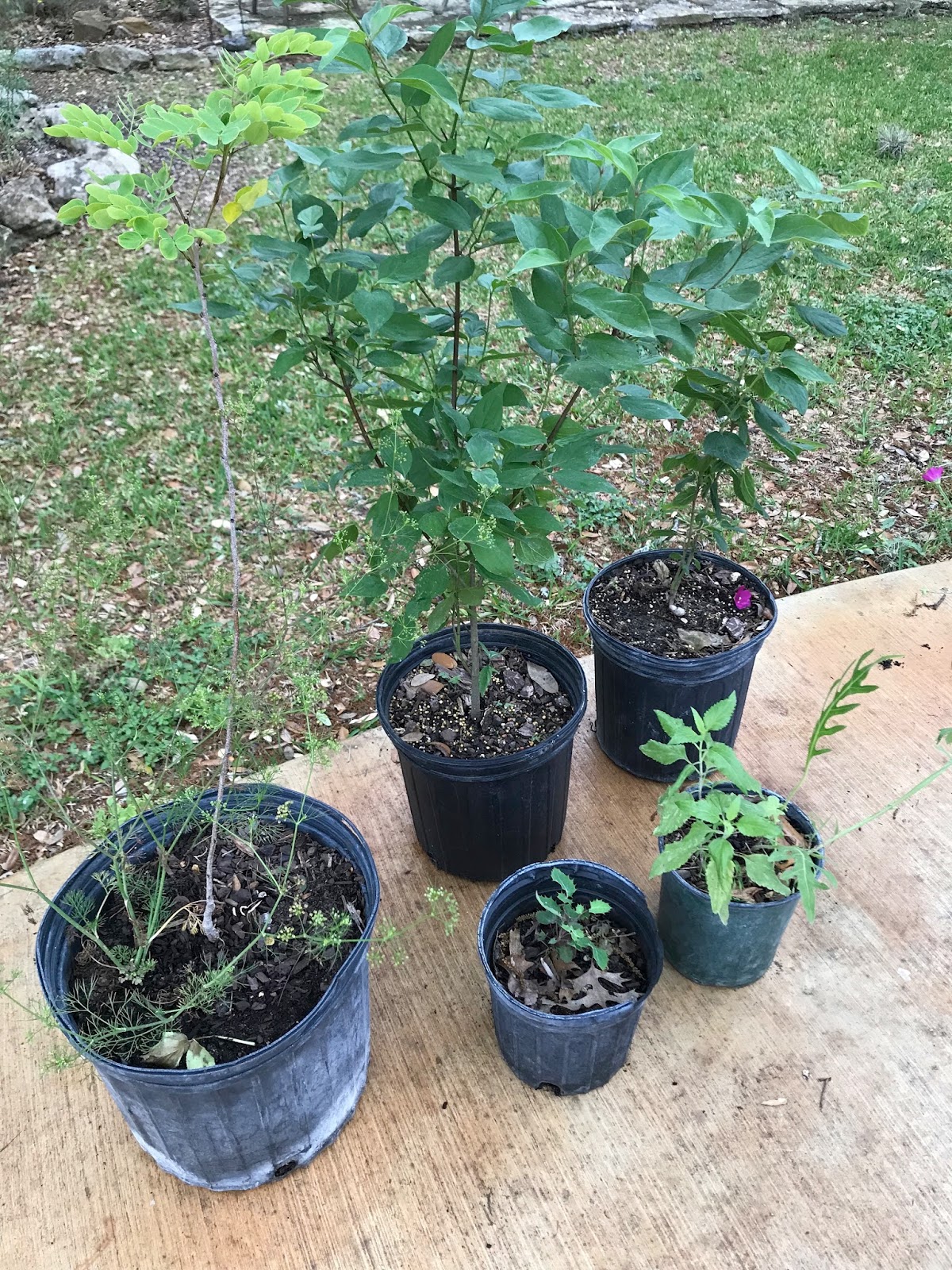
Meet our new native friends, purchased/adopted from the Medina Garden Nursery:

Compass plant (Silphium albiflorum)   
Goldenball leadtree (Leucaena retusa)
Redroot (Ceanothus americanus)
Roughleaf dogwood (Cornus drummondii)
Standing winecup (Callirhoe digitata)
Texas barberry (Mahonia swaseyi

Plus a ride-along–Prairie bishop (Bifora americana)


Happy anniversary!

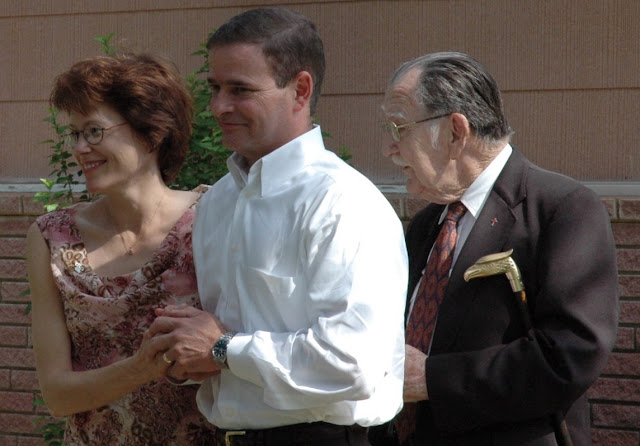
Upon a time, a handsome guy and a crazy lady got married by their close friend, the late Rev. Hiller, in a back yard ceremony on May 2, 2006. They've been living happily ever since! To celebrate the momentous occasion, they picked up her mother and headed west to scenic Medina, Texas, where they spent a few hours at a wonderful native plant place called the Medina Garden Nursery. (See, they knew firsthand it was wonderful because they'd been there before.)

Seriously, James, Mom, and I love the place and the partners who run it–Ernesto Carino and Yshmael Espinoza. Yshmael is passionate and very knowledgeable about native plants. You've just go to visit!


Ernesto and Yshmael upcycled optic fiber spools into a unique way to display their hanging baskets.
An East Texas penstemon
Their huge wildflower meadow...
Slender-leaf coneflower
Yshmael told us how they're experimenting with what's called "lasagna gardening," which layers paper, mulch and compost to create beds. James wants to look more into the idea, which is a form of permaculture gardening.

Crimson patch on a crownbeard.
Prairie bishop

Thank you, Ernesto and Yshmael! We'll be back! With love, Sheryl, James and Marcelle.

Tuesday, April 24, 2018

Bee-ware milkweed

While out surveying our antelope horns in the Meadow, I stopped to check out what was hanging out on the blooms. Sadly, I found a dead bee on one head. This is the first time I've observed a death caused by the sac-like bundles called pollinia that pollinators pick up while gathering nectar. I'd read that sometimes bees or butterflies get trapped by the pollinia and died but had never seen that happen until this evening. Poor bee.
I took some photos of another bee (below) so you can see the sacs attached to her legs. Below, I linked to a couple of videos so you can see and understand the process more clearly. It's really pretty cool and unique.


Antelope horns survey

So I just did a walk-by survey of the antelope horns in the Meadow. This year I counted 16 milkweeds on our side and two on our neighbor's side–a grand total of 18. Last year, I counted 15 antelope horns in the Meadow. In 2015, I counted eight. Yay! Little by little, we're growing our numbers for the monarchs and other pollinators.

Monday, April 23, 2018

Irises and amaryllises

Wow. I started this blog nearly TEN years ago! One of the reasons why is that I wanted to have a sort of gardening journal. A place where I could jot down when I planted this or where we bought that. Which is what I'm going to do right now–give an update on some bulbs that we planted in the past.

In a flower bed in our front yard, purple and white bearded irises have bloomed ever since my daughter and I moved into this house in April 2002. The bulbs were planted by the previous (and original) homeowners, the Bendeles. Through the years, we've added amaryllises gifted to us at Easter. In October 2015, James and I planted some pink 'Beverly Sills' bulbs that I ordered from Tulipworld.com. This may be the first time they've bloomed.


In February 2016, Ed and Cathy gifted us with some 'Tarleton' irises straight from Tarleton University in Stephenville, Texas. Ed's mother, who recently left for heaven, was a long-time resident of our neighborhood and  a dear friend. As you can see, one of the bulbs has bloomed! Beautiful. Thank you, Ed and Cathy!

Friday, April 13, 2018

Stock tank semi clean-out

Sheryl's to-do list: Cut back horsetail rush, check! 

Instead of a full-fledged clean out, I just cut off the horde of roots from around the horsetail rush. I also stuck in a fertilizer tablet into the dwarf water lily. Fingers crossed for lots of flowers this summer! Thanks for the photos, James!