Sunday, November 4, 2018

Caterpillar guide

Caterpillars can be tough to identify. And then try to remember which ones are which, based on what you've observed before! So I decided to compile a post of my caterpillar sightings, using both my blog and my iNaturalist observations. This will be a post that I'll update and better organize as I go along. I hope these help you out as well!


Giant leopard moth (Hypercompe scribonia)

Gulf fritillary (Agraulis vanillae)

  Variegated fritillary (Euptoieta claudia)
Pipevine swallowtail (Battus philenor)

Geometer moths (family Geometridae)

 Armyworm moths (genus Spodoptera) 

 Heterocampa astartoides (Heterocampa astartoides)
White-blotched Heterocampa (Heterocampa umbrata)
Cutworms and dart moths (subfamily Noctuinae)


 Snowberry clearwing (Hemaris diffinis)

Cutworms and dart moths (subfamily Noctuinae)


Tobacco budworm moth (Chloridea virescens)


Lassaux's sphinx moth (Erinnyis lassauxii)

Obscure sphinx moth (Erinnyis obscura)
 
Obscure sphinx moth (Erinnyis obscura) 

 
Five-spotted hawk moth (Manduca quinquemaculatus)


Rustic sphinx moth (Manduca rustica)
 Carolina sphinx moth (Manduca sexta)

Tersa sphinx (Xylophanes tersa)

 White-lined sphinx moth (Hyles lineata)

Queen (Danaus gilippus)
Monarch (Danaus plexippus)

Genus Phigalia

 Black swallowtail (Papilio polyxenes)

Eastern tiger swallowtail (Papilio glaucus)

Grote's buckmoth (Hemileauca grotei)

 Lantana moth (Diastema tigris)

Pug moths (Genus Eupithecia)

 Ilia underwing (Catocalia ilia)

Genista broom moth (Uresiphita reversalis)

Cutworms and dart moths (subfamily Noctuinae)

 Salt marsh moth (Estigmene acrea)

 Bordered patch (Chlosyne lacinia)

Crimson patch (Chlosyne janais) 

 Theona checkerspot (Chlosyne theona)

Southern dogface (Zerene cesonia) 


Black swallowtail (Papilio polyxenes)

Flannel moths (family Megalopygidae)

Forest tent moth (Malacosoma disstria)

Genistra broom moth (Uresiphita reversalis) on blue wild indigo
 Large yellow underwing (Noctua pronuba)

Yellow-winged Pareuchaetes (Pareuchaetes insulata) on Gregg's mistflower
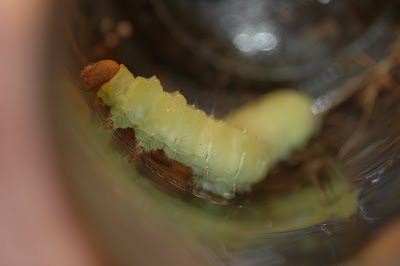
Polyphemus moth (Antheraea polyphemus)

 Maybe Geometridae family
Nematocampa sp.
Lycia sp. 
 Gray hairstreak (Strymon melinus)

  Eight-spotted forester moth (Alypia octomaculata)
 
 
Acronicta atristrigatus (dagger moth)
 
 Milkweed tussock moth (Euchaetes egle) on green milkweed vine
 
Southern flannel moth Also called a puss moth and asp (Megalopyge opercularis)

Common sawflies (Tenthredinidae)
 Mallow sawfly (Neoptilia tora) on velvetleaf mallow

Once upon a caterpillar

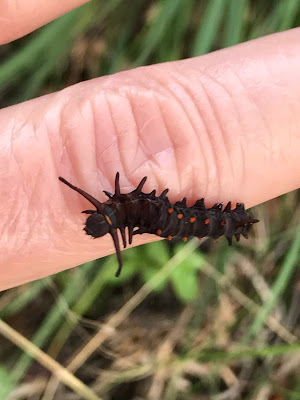
Last Thursday, my friend Shena and I took a long walk. Along the way, I happened to look down and see a small pipevine swallowtail (Battus philenor) caterpillar, scooting along the asphalt. Since I didn't know where there was any native pipevines growing, I scooped up the youngster and took it home. Now maybe this caterpillar would have eventually found something to eat, but I didn't have the heart to leave it on the bare pavement.


I may get fussed at, but I took the caterpillar home because we grow pipevines in our Wildscape. Gently, I put it on a Aristolochia fimbriata leaf, and it began to eat. Caveat: That pipevine species isn't native. So I kept an eye on my young friend, and it soon stopped eating. The next day or two, it still wasn't eating. I felt terrible.
Yesterday afternoon, I relocated the caterpillar to our swanflower (Aristolochia erecta), which is a native pipevine species. I was VERY happy when I finally saw it begin to eat. This afternoon, it was eating some more. I'm definitely feeling better. I hope my little caterpillar friend is, too!
 
* * * * *

 UPDATE November 7, 2018
* * *
UPDATE November 11, 2018

* * * 
SAD ENDING November 18, 2018

 Two hard freezes hit last week while were out of town, and my little friend froze to death. I'm so sad.

Grape hyacinth bulbs

(Photo Wikipedia)
Last spring, I dug up (with permission) some grape hyacinth bulbs from a vacant lot owned by the Lutheran church here in town. I put them in a pot and forgot about them. Last week, I got to thinking about ALL those bulbs still left in the ground. So I contacted Pastor Dayna and asked when they planned to start on their parking lot. She said they were in the process of obtaining permits. Maybe 30 days? YIKES! When I suggested that we have a dig party to rescue what we could, she agreed. So Friday morning, Dayna, James and I along with Kathy and Yvonne braved chilly temperatures and dug dug dug. 

Yesterday, I returned to the vacant lot and met up with Peggy and her husband Dean, who came to dig up bulbs and native plants.  What's more, Dana and her granddaughter Skyla drove all the way from Comfort to dig up grape hyacinth bulbs. "They remind me of my grandmother's yard," she said. "I've been searching for YEARS for them." Afterward, everyone drove over and toured our native gardens. How wonderful–we all made new friends, thanks to one little bulb.

NOTE: Grape hyacinths aren't native to Texas. But they are considered to be heirloom plants. So they're special in their own way, just like indigenous native plants are. We now have some in our gardens.


Yvonne
Dayna

James

Kathy

New-to-me species

I got to play detective this week. Well, actually I play that a lot here in our Wildscape. That's why I love nature so much. There's always something new to learn. But I digress. Back to playing detective... 

Several of us recently dug up grape hyacinth bulbs in a "vacant lot" that will be paved soon here in Blanco. During the course of surveying the area, I came across a vine that I'd never seen before. I took photos and sent them to a couple of plant experts I know. They were stymied, too. So I dug through plant families on iNaturalist, mostly morning-glory (Convolvulaceae), based on the seedheads. The leaves vaguely reminded me of another plant, but I couldn't place it. Then I found crest-rib morning-glory (Ipomoea costellata)–BINGO! That was our vine! Then I knew which plant was I thinking of–Alamo vine (Merremia dissecta). The two vines have leaf shapes that are somewhat similar. And yes, I transplanted some crest-ribs to our gardens. It's an annual so I don't know if they'll take, but I wanted to try as a way of preserving the species. 

NOV. 6, 2018 UPDATE: This has been identified as Edwards Plateau morning-glory (Ipomoea costellata var. edwardsensis).