Showing posts with label invasives. Show all posts

Wednesday, March 13, 2013

I Hate Malta


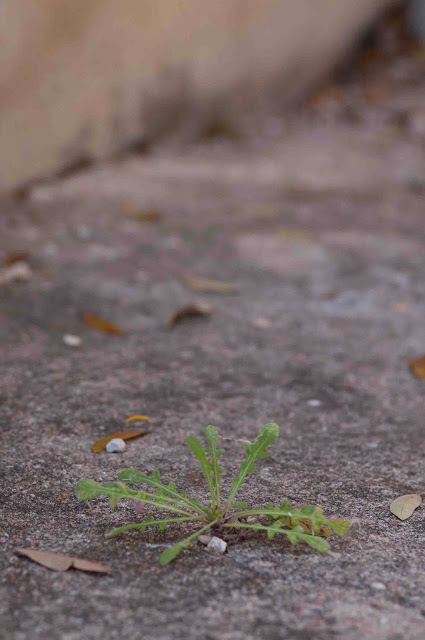
This devious Malta star-thistle (above and below) managed to sprout in CEMENT.

Yes, I hate Malta.

As in Malta star-thistle. Centaurea melitensis, to be precise. I hate it. I really do. "Wicked, it's wicked," I mumble to myself as I search for, yank and pull out the stuff. From a yard away now, I can spot a Malta seedling. I've become that much of an expert at identifying the various stages of growth.

I've also declared all-out war on the invasive species. It will NOT inhabit our Wildscape. It will not. It will not.


Toward that goal, I've employed the use of 9 percent vinegar to kill older plants. Monday afternoon, I used a coffee-grinder cleaning brush to "paint" vinegar on the foliage. Below are photos of what the victims looked like Tuesday.


Yesterday, I returned to the execution scene and POURED some vinegar on the dratted thistles (below)....I can't really say that the vinegar is killing them as fast as I'd like. So I guess I'll stick with good, old-fashioned hand removal.


Saturday, January 5, 2013

Be gone, invasives!

Happy new year! Thank heavens, 2013 so far has brought moisture. OK, it amounted to less than an inch, but every bit helps!

Today, we had some sunshine so I ventured outside awhile ago to check what's happening in the Meadow. Uh oh. The Malta star-thistle (Centaurea melitensis)––one of our BAD BAD BAD invasive species (up there with bastard cabbage––is sprouting rosettes. Last March, I blogged about this annual thistle after I realized we had it growing in our Wildscape. For several evenings, James and I pulled piles and piles of it, hoping to get it under control. This afternoon, I spent some time, pulling up the few I could find. They're really not hard to identify....

Malta star-thistle has ruffle-edged leaves. 

Even when they're small, the ruffled leaves are obvious.

I used an old fork to grab and pull up the thistles.

Can you spot the Malta star-thistle? It's trying to push out a stork's bill.

Tuesday, April 10, 2012

Confession time


My intended mid-afternoon mission: shoot a photo of a little mystery plant so I could get it identified. Then I looked over and saw red admirals...lots of them....my very favorite butterfly...on the blooming Chinese privet. GROAN! As many of you probably know, Chinese privet is an invasive, not to mention against the rules if you have a Texas Wildscape. That privet has been growing here since before I moved in 10 years ago. I know, I know...no excuse. Hey, I'm confessing!

But I will tell you that James and I had just recently agreed to cut it down and replace it with a native species–rusty blackhaw viburnum (Viburnum rufidulum). I got the idea when I saw a photo on Facebook of a red admiral nectaring on a viburnum. Hopefully, Katy, a neighbor's kind granddaughter, will buy us a couple from this weekend at the Native Plant Sale at the Lady Bird Johnson Wildflower Center. I'd like to let these flowers bloom first (for the butterflies), then we'll execute...I mean, we'll cut that privet down.


Monday, April 9, 2012

Bill Neiman on bastard cabbage

Recently, a Texas Master Naturalist in our Highland Lakes chapter shared an article on bastard cabbage that is posted under "Recent News" (April 4, 2012) on the Hill Country Alliance website. The author is Bill Neiman, who co-owns Native American Seed (Junction, TX) with his wife, Jan. In years past, I've interviewed Bill twice and have the utmost respect for his knowledge about native species. 

With his permission, I've reposted his thoughts on Rapistrum rugosum here:


Some, including the media, could deepen their bastard cabbage research just a little.
 

The seeds of bastard cabbage are NOT very small like rye grass. As far as seeds go, they are actually quite large and round ... they fit in the exact same size hole as wheat and cereal rye GRAIN on a seed cleaner. TXDOT uses these very low priced cereal grains as an economical, cool season, temporary vegetation for erosion control on fall/winter-seeded roadside construction projects. It is specified in the TXDOT Standards for all 254 counties. They used it last fall to stabilize areas impacted by the Bastrop Fires, for example.
 

Some cereal grain seeds that come into the lowest-priced-ends of the market may have never been through a seed cleaner. Many farmers trade, buy, and sell "combine-run" seeds, straight out of their harvesting machinery. The age-old tradition to save your own seed is a good thing, especially in this day of global trading and genetically modified organisms. But many a contaminated wheat field exists in the blacklands and beyond. And it’s the lowest priced bid that state purchasing offices rank as the highest qualifying vendors. As long as TXDOT keeps funding the planting of contaminated cool season grains, we can expect more of this invasive weed into the future.
 

Bastard cabbage and TXDOT are not to be singled out as culprits. In the bigger picture, take a holistic look at your own landscape to see what’s happening to our environment. There are many, many alien species to tackle... and many conduits for their expansion. All of us can improve the health of our lil’ corner of the planet, one property at a time.
 

It is hard to say what the future will be, but one thing I know for certain is exactly why the Comanches fought so hard for this land. The Texas Hill Country is a treasure I don’t want to lose.
 

Bill Neiman 
Native American Seed 
solutions for eco-logical land mgmt 
www.seedsource.com


POSTSCRIPT: My friend, Kip, pointed out that Bill's remarks were in response to coverage on the invasive species by KXAN in Austin: Bastard cabbage attacks!

Wednesday, April 4, 2012

We have to keep up the good fight

Email exchange today between myself and Ricky Linex, a wildlife biologist with the Natural Resources Conservation Service in Weatherford. (We met at the Riparian workshop last week.) 


Hi, Ricky: I just got in from taking a break at my desk to go pull thistle. I just see more and more of it. It's IN our meadow and our neighbor's adjoining lot. At least they mow theirs. We let ours go for the wildflowers. But I'm just really depressed. We'll NEVER get it all pulled before it goes to seed. Plus, it looks like some has already gone to seed at the bottom-most flower nearest the ground. This stuff is WILEY.

ARE we doing any good by going out there every day and pulling the thistle? It feels pointless. It looks like it's gonna win.

Thoughts? Now excuse me while I go sit in a corner and bawl.

sheryl

P.S. I LOVE my Master Naturalist classes. But, like I told my husband, now I'm getting even more things to worry and obsess about. :-)


Ricky's reply:

Knowledge is a scary thing isn’t it?  I read your "Does it Matter?" post last night.

This week, we set up a wildlife contest in Palo Pinto County for FFA and 4-H students. From the highway, we had to travel 2 miles down a gravel road to the ranch, then 4.5 miles down a ranch road to the area chosen for the contest. Over 75 percent of the distance along the ranch road had malta star thistle growing on one or both sides of the road. You first ask yourself, How in the world did this plant get there in the first place? If it was along a public highway, I could understand how seed could have been deposited along the route, but this road has seen little traffic other than the rancher. 

However, the ranch just completed a large pavilion last month at the end of this road. Cement trucks, carpenters, lumber delivery trucks, plumbers, electricians, stone masons, septic installers and water line installers have all traveled that road in the past six months. That likely explains how a remote area could be contaminated by the seeds. If such a remote area can be affected, what hope is there to keep it out of more public areas? It is just showing up everywhere this year, like an explosion of thistle trying to cover the ground that was exposed by the drought of 2011.

I walked along a creek in Hamilton County yesterday and saw the thistle there. If you are looking, you will find this thistle. It must be the year of the thistle. It may now be time to go to a diversified control using chemicals on small plants (<6 inches tall) and continuing to pull large plants to prevent seed production. The weed eater may also work on those tiny seedlings present after pulling the larger plants. Begin monitoring the mowed areas to see if the thistles continue to grow with side branches.

Remember what Winston Churchill said during WWII: “We shall defend our island, whatever the cost may be, we shall fight on the beaches, we shall fight on the landing grounds, we shall fight in the fields and in the streets, we shall fight in the hills; we shall never surrender." 

We must be like the British and continue to fight, never giving up. But the fighting has to involve more than just one or two caring souls it must include the entire neighborhood, the entire city, county and even the state to push back this threat.  

It is a good fight. Keep up the good work.


Monday, April 2, 2012

Does it matter?

I just spent more than an hour, pulling Malta star-thistle from our Meadow. All I could think was What does it matter than I'm doing this? What does it matter?

Does it?
I pulled up more. But I saw so many little ones that we'll surely miss.

So what difference does it make?

Can anyone tell me?

So what? Cars drove by, and people looked at me, bent over in the field. Crazy lady, what's she doing, they probably thought.

I know we're doing the right thing. And that the native plants will benefit.

But more thistle will replace what we've pulled.

So what difference does it make that we even try?

Can you tell me? Do YOU even care?

BIG P.S.

I was researching star-thistle and ran across Commander Ben, The Invasive Hunter. He's a young man, 12 to 13ish, who is VERY enthusiastic about fighting invasives (and lives in the Austin area, I think). He's even got his own YouTube channel! Now THAT'S encouraging to know that young people like him CARE! Check him out! 


Saturday, March 31, 2012

Another bad invasive: Malta star-thistle


Malta star-thistle (Centaurea melitensis)
Similar species is yellow starthistle (Centaurea solstitialis)

Here recently, I must admit that I felt a little relieved to know that we don't have the bastard cabbage (Rapistrum rugosum) in our neighborhood. Then last Wednesday, I met Ricky Linex, a wildlife biologist with the Natural Resources Conservation Service, at a Riparian Workshop (part of my Texas Master Naturalist training). On a creek bank near Horseshoe Bay, he pulled up a dark green plant and said it was the invasive thistle he mentioned to me earlier.

Malta star-thistle (Centaurea melitensis). It's just as bad as bastard cabbage.


Hmmm.


In the meantime, James and I had been eyeing a healthy crop of big green plants growing along the street that adjoins the Meadow. Uh oh.


After I got home, I took a closer look at the plants.


Dang.


We've got Malta star-thistle IN OUR WILDSCAPE!!


Yesterday evening, James started pulling it up. I pulled up more around noon today and walked across the street, too, to yank up some growing in our neighbor's yard. We've got a LOT more to pull. And there's more young ones coming up.


Drat.


Sigh.


Just now, I reported our thistle to Early Detection & Distribution Mapping System, a web-based mapping system for documenting invasive species distribution. My Record ID for the Malta star-thistle is 2027636. 


LATER THAT EVENING...

Here we go after supper, back to work on the Malta star-thistle. Bad stuff! Last year, the city scraped this side of the street for sewage work, and then left it be. We should have tried to reseed it, I guess. At any rate, this thistle showed up in full force.
It took everything I had to pull up some of the thistle!!! I think it should have a similar name as that bastard cabbage....

Daunting work, but we kept at it.

I asked James to take a photo of what's UNDER a cluster of thistle. NOTHING.

James won the prize for the biggest thistle of the evening.

We removed the majority of the Malta star-thistle...for now. We'll have to keep pulling until hopefully we win and not the thistle. 

* * * *


More info on invasives:


National Invasive Species Information Center

Invasive Species, AgriLife Extension, Prairie View A&M University


UPDATE APRIL 2, 2012


I asked Ricky some questions about best how to control the species:

"There are chemical methods, but the plants might still produce seed because of the length of time required for the chemical to work. Hoeing or pulling will get roots and all. According to a forest service pub mowing and I suppose weed-eating can cause the plant to send out side branches. Google "Field Guide for Managing Malta Star-thistle" to read more."


Can the piled up bunches of pulled thistle still make seeds?


"If it hasn't produced yellow flowers, it won't now make seed. The ones you've pulled were caught early so they are done. And forgot to add that the untouched plants will bloom different heads through early summer."

UPDATE, MAY 12, 2012

I am still pulling Malta star-thistle and beggar's ticks (Torillis arvensis), another non-native. The species is also called hedge parsley. You've seen the stuff...it has pretty white flowers that resemble baby's breath or Queen Anne's lace. Then the flowers turn into nasty burrs that stick to socks and fur. As I was yanking the plants, I noticed that the species--like most invasive weeds--crowds out everything and creates a monoculture (nothing grows under it)!


My pile of thistle and beggar's ticks.


Friday, March 30, 2012

Riparian workshop

Ricky Linex (center in blue shirt) and Kenneth Mayben, both with the Natural Resources Conservation Service, led a Riparian Workshop this week.


Tubing on the Guadalupe River. Splashing in the Blanco River. Stepping along a gurgling creek that runs through your property. We relish time spent at our special places in and near water. But riparian habitats–those transition zones that link wetlands to uplands–are one of our most endangered ecosystems.

“They are loved to death,” Sammye Childers told us this week in a Riparian Workshop held at The Trails of Horseshoe Bay.

As part of our Texas Master Naturalist training with the Highland Lakes chapter, Childers, our training program coordinator, scheduled the extra day-long class, which was also open to certified Master Naturalists and Texas Master Gardeners.

Ricky Linex, a wildlife biologist with the Natural Resources Conservation Service in Weatherford, gave an overview of riparian function. “Every creek is different, but they have similarities,” he said.

A number of myths muddy people’s basic understanding about creeks. “They think floods and droughts are bad,” Linex said. “They also think streams should be wide and straight.”

Other myths that we’d learn are wrong: dead timber clog up streams and should be removed; removing vegetation will improve stream flow; steep cut-banks are bad; if a watershed’s in good condition, so is a stream; and riparian areas should be burned and grazed, and brushed controlled in order to maintain or restore desirable vegetation.

“Soil–water–vegetation are like gears meshing. The ideal is for all those to connect and mesh finely together,” Linex said. “A properly functioning riparian area has adequate vegetation, land form and large woods.” Vegetation and woods slow down a stream energy (force of a water flow) while stabilizing banks, reducing erosion, trapping sediments (which builds a floodplain) and store water.

Next, Linex gave a quick lesson in hydrology. “How we manage rain is one answer (to our water problems),” he said. A grass blade dissipates the energy of one raindrop falling. So established grasses help the land to slow down runoff in a watershed and store it, which benefits creeks and riparian areas.

Ranchers and private landowners can better protect their creeks by managing the time that livestock spend near them. He recommended alternate water sources be installed away from creeks in fenced pastures; rotational grazing and also fencing off creeks. “Livestock can graze a riparian area, but it must be managed,” he added.

Next, Kenneth Mayben–an engineer with the NRCS–discussed fluvial geomorphology, potential versus capability of a stream, bank full discharge and bank full flow, channel geometry, width/depth ratio, sinuosity, headcuts, active and abandoned floodplains…the three-hour class felt like a semester’s worth of information. Our heads were swimming!

Good read: Mayben recommended A View of the River by Luna B. Leopold. “It changed my thinking about rivers,” he said.


After Mayben’s presentation, Linex discussed the role of grasses, sedges, forbs, shrubs and trees in a riparian area. Some colonize (like spikerush and watercress), others stabilize the soil (like switchgrass and emory sedge).

Some recreational use of creek banks is fine, provided at least 70 percent remains natural (with plant coverage), Linex said.   

After lunch, we ventured out beneath gray, drizzly skies to explore and learn more about streams and creeks....


Lindheimer muhly

Kenneth Mayben shows us the differences in soil found in riparian and upland areas.

Linex points out more native grasses.

An elbow bush (we have one in our Wildscape).


As we walked along the creek, M.J., my classmate, told me to look up and "take a picture of that!" If you look closely at the oak limb above the lady's heads, you'll see.....

...a prickly pear cactus growing!!


Ed stands next to a bunch of little bluestem (it's a little hard to see in the photo).

Linex shows us a Malta star-thistle (Centaurea melitensis), an invasive that's as bad as the bastard cabbage cropping up everywhere.

Here's how to tell the difference between native and nonnative thistles.

Spike rush

Boneset


A friendly and HIGHLY energetic teen pup accompanied our group. (Hope she found her way back home!)


I love sedums.

Last leg of our Riparian Workshop with Ricky Linex and Kenneth Mayben.

Read more: 

   * National riparian specialist Wayne Elmore's restoration work in Orgeon (article published in 1998).
   

Saturday, March 24, 2012

Beware: bastard cabbage invading!

Pulling bastard cabbage at Blanco State Park

Earlier this week, Jeff from San Antonio e-mailed me, asking if I knew the name of the yellow flower that he's been seeing around the Hill Country. 

"I usually ride my bike on the weekends with some other folks in the hills to the north and other areas around San Antonio," he wrote. "In the last several weeks, I have noticed an abundance of yellow flowers on tallish green stems,maybe 2 to 3 feet tall. I was wondering if you might know what these are. They seem to be everywhere, even down in town. I just noticed some along the access road at 1604 and Blanco."

Bastard cabbage (Rapistrum rugosum), I replied! A highly invasive species! 

I've since learned (and observed firsthand today) that the cabbage crowds out native plants with a vengeance. [West AND east of Blanco, the abundance of bastard cabbage growing on roadsides and across pastures is SCARY. Hey, it's growing EVERYWHERE!]

A day or two after Jeff e-mailed, Connie with the Highland Lakes Master Naturalist chapter (my group) sent out a call for volunteers to pull bastard cabbage at Blanco State Park. This morning, James and I joined a group of 10 or so people who worked three or more hours. Many were with our Master Naturalist chapter; others came from the Capital Area chapter in Austin. A few were Highland Lakes Master Gardeners. A few just volunteered because they wanted to help!

As you can see from the photos that James took, we made some progress. But there is LOADS more of this terrible plant in the park.

So what's the skinny on this scary invasive? According to the Plant Conservation Alliance, annual bastard-cabbage comes from Central Europe, the Mediterranean, northern Africa and parts of Asia. But no one's really sure how it got here. The Alliance has posted an online fact sheet on the species.


How do we get rid of it? Pull it, taproot and all. Invasive plant expert Damon Waitt, who's worried, recently talked in length with KXAN in Austin about the problem: "Bastard cabbage attacks!"

UPDATE APRIL 9, 2012

More links:

Bastard cabbage gains ground among wildflowers, Houston Chronicle 

The dastardly bastard cabbage and what it is has done to Texas Bluebonnets, Houston Press


Across the Blanco River in the park, more more more bastard cabbage flourishes.


Midway through the morning, around 10 boys with Boy Scout Troop 485 joined our project. They were VERY enthusiastic!

Bastard cabbage blanketed this slope until we volunteers yanked it all up.

There was cabbage on this slope, too, until volunteers removed it.

After three hours of pulling, Sheryl left VERY VERY tired! Bet everyone else did, too!

 * * *
UPDATE MARCH 30, 2012–The Blanco County News published an article, "Cabbage invasion," and printed one of James' photos.