Saturday, May 22, 2010

Pseudoscorpion

Peyton came over yesterday afternoon with his friends, Griffin and Tristan, to check on the Gulf fritillary caterpillars. They are very curious about EVERYTHING! Peyton lifted up the lid to our underground propane tank and came across this teeny-tiny arachnid on the lid. I checked Bugguide.net this morning and learned that it's a pseudoscorpion. Yes, this arachnid species has poison in those little pincers to subdue prey, but heck, the pincers are so small that they couldn't do much to humans. This species can run backward, too! The boys and I saw this one do that.


Thursday, May 20, 2010

'Belinda's Dream'

'Belinda's Dream'
Texas Superstar

A gift from my sweet husband in honor of our fourth aniversary on May 2.....fragrant, pink roses!

One of the two original rose bushes that came with the Pink House in 2002 died after last year's drought. I thought that if I ever bought a rose bush to replace that one, it'd be 'Belinda's Dream.' The thing is, I never mentioned that to James. Isn't that amazing? Or perhaps true love....

The live oak gurgles


As we were roaming around the front yard this evening, we happened to spot several butterflies congregated on a live oak. Cool! But as we looked closer, we realized they were actually sipping from the tree. It'd been oozing. Then....I heard something.....like gurgling! I looked even closer and saw bubbles coming from the dark brown crack in the bark. Not good. Not good at all! So I'm going to contact biologist Robert Edmondson with the Texas Forest Service in Johnson City and ask if we should be concerned.

As for the butterflies, I believe they were variegated fritillaries. But I'm not sure.


UPDATE E-mail received 5/21/2010 8:30 A.M.

Sheryl, what you are observing is nothing to be concerned about. That is a condition known as phloem necrosis or “slime flux.” It’s caused by a bacteria in the tree. As the bacteria goes through its life processes, it produces that “slime.” It’s merely a by-product of a fermentation process. It’s not harmful to the tree; there is no known treatment and it provides food for insects, especially butterflies. Elms and oaks are the most common tree species where this occurs. Again, don’t worry about it. It is not harming the tree.

Robert Edmonson
Biologist II
Texas Forest Service

One vicious guy


James spotted this strange critter along the edge of the street. It was ugly and very aggressive. I did upload an image to Bugguide.net and got this one comment: "It appears to be a beetle larva of some kind. I'll look around a bit, but I'm sure one of the experts will tell you what it is before I get back." He also posted this link to a similar specimen–a ground beetle larvae. Not even a mama could love this guy!

UPDATE–Someone on Bugguide.net confirmed: "Yes, a carabid, likely, Calosoma (genus)."

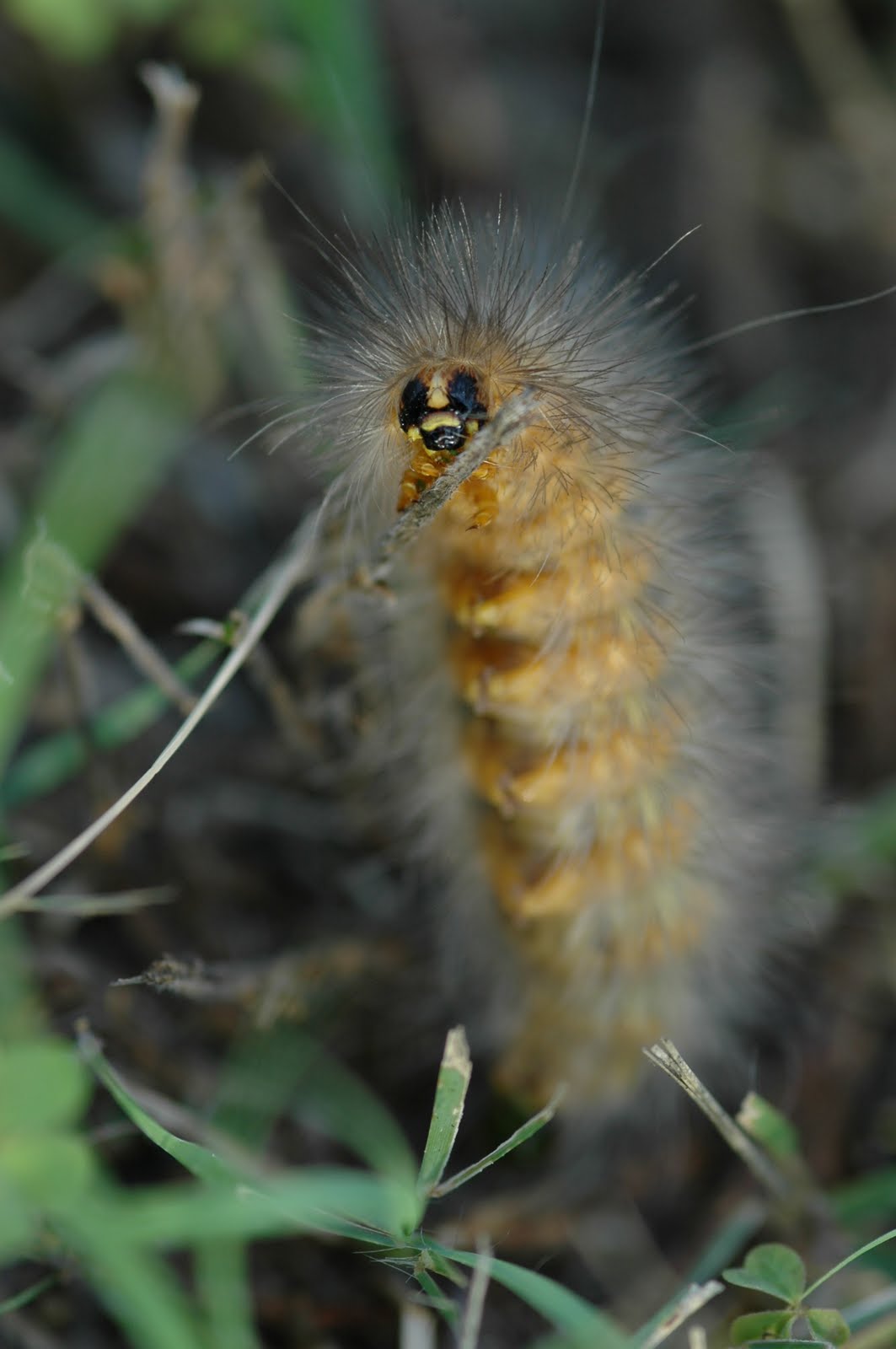
A woolly caterpillar for Peyton

My new neighbor, Peyton, turned 11 today. But I didn't know that when James and I walked over with chocolate chip cookies I'd baked to welcome them to the neighborhood. Good timing. During our quick visit, he showed me a plastic container of assorted caterpillars and pillbugs, including what I used to call a woolly bear. Later in the morning, I pulled out my Caterpillars of Eastern North America to find out for sure. I think these fuzzy guys are either salt marsh caterpillars (Estigmene acrea) or yellow bears (Spilosoma virginica). I need to do more research on this. Because I want to get it RIGHT!

Anyway, I happened onto one in the middle of our street. A car was coming. So I wanted to hurry it up across to the grass. Nope. It didn't like my prodding. So it proceeded to...ah...squirt out some green stuff from its end. Yuck. But no time to lose. So I scooped it onto a piece of wood and hurried it over. Whew. We made it! Then I fetched my camera and shot these photos for my new friend, Peyton, the Pillbug Expert.

Happy Birthday!!


Lost Ladybug Project


Harmonia axyridis, the multicolored Asian ladybug.
Found on passionflower vine.

UPDATE E-mail received Thu 5/20, 9:54 P.M.

Dear Sheryl,

Thank you, again, for your contribution to the Lost Ladybug Project. Your submission can now be viewed in the Contributors section of the Lost Ladybug Project website, here: http://lostladybug.org/contributors-images.php?id=1062

This "face-shot" is fantatic!

Sincerely,
The Lost Ladybug Project
www.lostladybug.org

New vine

Not Virginia creeper, which has five leaves. Or poison ivy. I think. I'm trying to figure this one out. We found in the Meadow on a live oak.

UPDATE May 29, 2010–Case solved. Sorrelvine, cow-itch vine (Cissus trifoliata), a member of the grape family. According to Wildflowers Trees, and Shrubs of Texas, it can cause contact dermatitis in some individuals.