Sunday, February 20, 2011

Pollination underway


Dang, I'd never noticed this shrub thing blooming before, and I have no clue right now what it is. What I do know is what it's NOT: wax ligustrum and privet. But the bees and flies were all over it this afternoon. And it smelled good, too. Help, anyone?


UPDATE–I finally took the time to check on this new-to-me species, and reader Mkircus was right! Cool! This is a stretchberry–also called an elbow bush–Forestiera pubescens. I'd never noticed it before. Or maybe I had but didn't have the interest that I do now in natives. I'm going to tie a little ribbon around one of the branches so I can tell it apart from other shrubs going in the Sanctuary corner of our Wildscape. Neat-O!


Just a snail

Another day I'll figure out what genus and/or species of snail this is...it just happened to catch my eye.


UPDATE MARCH 24, 2011–This just in from snail expert/Mollusk Man Max S. Anton: "Your snail is almost certainly Otala lactea, though there may be some similar Helicidae in your area whose species have not yet been differentiated. But in all probability, it's a milk snail. Great blog, by the way. And that photo is fantastic. Please let me know if you post more snail-related articles, I'd love to see them."
Thank YOU, Max! 

As for Otala lactea, it's nonnative. 

According to "Snails and Slugs" written by the late J.A. Jackman, "Other exotic land snails are also garden pests in Texas. Milk snail, Otala lactea, is often common in many parts of Texas, particularly in urban areas, and chocolate-banded snail, Eobania vermiculata, has populations in central and southeastern Texas. Both are closely related to brown garden snail, but are slightly smaller in size. Both have also been used as escargot."

Get out the forks?

More from Max: "All Helicidae are exotic, having been imported from Europe and Asia Minor. The milk snail is formerly known as the Spanish Edible Snail, so it is probably more closely associated with the Iberian Peninsula and North Africa. I'm not sure how Otala lactea found its way specifically to the Hill Country, but most likely, it migrated there after being introduced in other parts of the country for the escargot trade. Snails have a knack for hitching rides in potted plants, shipping crates, and other transported goods."

Spider camo


A movement in the grass caught my eye this afternoon, and I leaned down to see what it was....a crab spider! VERY well camouflaged, too. See how she blended perfectly with the grass and dead oak leaves? Then, when I poked around her to pull away the dead grass, she stretched her legs out and went into a defense position. Look out, I'll get you, she warned. Even if she tried, her bite wouldn't bother me at all. She was way too small.

Nature just never ceases to amaze me. I've seen a variety of crab spiders, like pink and yellow and rusty brown ones, but never one that blended in with dead vegetation. Cool!


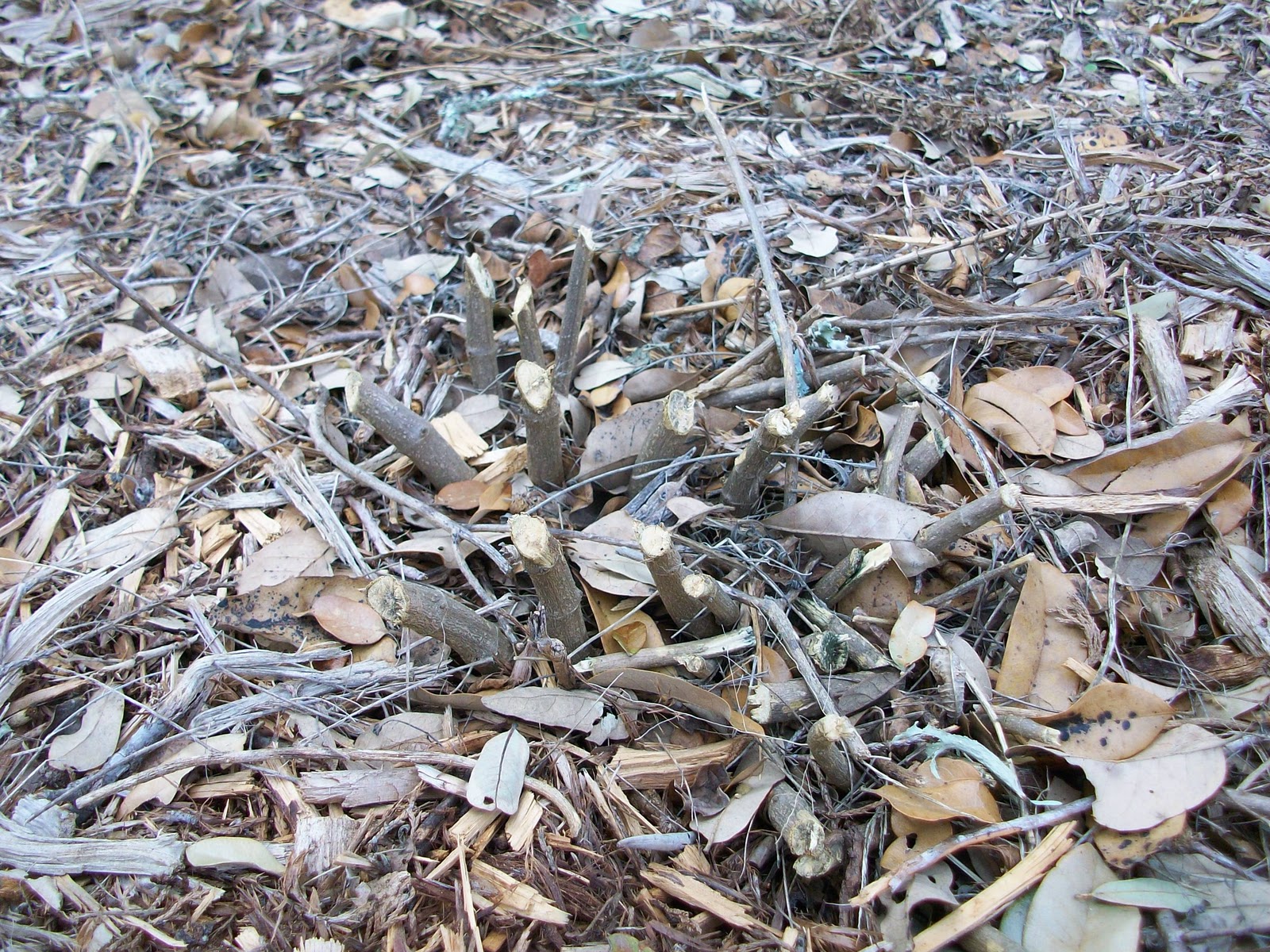
The pruned ones...

The rose bush that's lived longer at the Pink House than I have...
'Indigo Spires' salvia
Firebush

Copper Canyon daisy
Butterfly bush
Mexican bush sage
Wedelia (zexmenia)


American beautyberry

First daffodil

Spring's coming!!

Thursday, February 17, 2011

Daffodils and ball moss

The daffodils are about to bust open!
Ball moss seeds have been floating in the air like fluffy snowflakes the past few weeks. Some get stuck on the chain-link fence, and I couldn't resist photographing one.

Readin' up

I've been wanting to pull out reference books and information on native plants so we can better prepare for the new growing season. So this afternoon is The Day! I'm reading over plant lists and mulling over LOTS. 

For one thing, I KNOW I'm going to the Mostly Native Plant Sale, set for April 2 in Boerne. Hosts are members of the Boerne chapter of the Native Plant Society of Texas. And I've already queried David Winningham at Natives of Texas and asked if he might bring some spicebushes to sell. Yes, he responded. In the meantime, check out his website for information on which native plants like shade and/or sun. He's also got an online catalog of the natives he has in inventory. Can't wait for the Boerne sale! James and I visited Natives of Texas several years ago, but we weren't as up to speed on natives back then as we are now.


Back to the books!