We ate our supper outside on the patio for the first time this season. It was WONDERFUL! It got EVEN better when I spotted a robin. Then another. Then James pointed out more.
SIX ROBINS in the Meadow! I'd say spring has sprung!
UPDATE MARCH 5, 2011–Our friend (and monarch watcher), Kip Kiphart in Boerne told me that I should report this sighting to Journey North. Which I just did this morning!
What is Journey North? That's what I wanted to know.
Here's what the website says: Journey North "engages students in a global study of wildlife migration and seasonal change. K-12 students share their own field observations with classmates across North America. They track the coming of spring through the migration patterns of monarch butterflies, robins, hummingbirds, whooping cranes, gray whales, bald eagles— and other birds and mammals; the budding of plants; changing sunlight; and other natural events. Find migration maps, pictures, standards-based lesson plans, activities and information to help students make local observations and fit them into a global context. Widely considered a best-practices model for education, Journey North is the nation's premiere 'citizen science' project for children. The general public is welcome to participate."
Cool.
Thursday, February 24, 2011


Wednesday, February 23, 2011
ShaZAM!!
 |
Look back at my post, "So much life" (October 19, 2008), and you'll see this photo of an ant. "A rather large species of ant" was my caption.
This week, I'm researching ants for a magazine project. Since I'm getting more smarts about different species, I thought I'd go through my blog and see if I had any images of ants. This one popped up. Curious, I clicked on the picture and peered at the thorax (an ant's middle section). Hmmm. Then I looked at the head... Hmmm. Hey, wait a minute! Next I went to Bugguide.net and pulled up some ant images. Hmmm. Then I did another search. OH WOW!
"JAMES!" I hollered. "COME SEE THIS!!"
Good sport that he is, James walked into the office and stood next to my desk. "What's that look like?" I said, pointing to the picture.
"An ant," he said. Naturally. I grinned.
"Ah, look CLOSER," I said, beyond excited. "What's it MISSING!?"
James looked closer. Then he shrugged. "I dunno."
"MANDIBLES!" I exclaimed (like I'd found loose coins on the ground or some such treasure). "ANTS HAVE MANDIBLES!" Then I pointed to the long, thin beak coming from the insect's mouth end. "THAT'S A BUG! AN ANT-MIMIC BUG! Isn't that just COOL!?"
"That's nice, Sheryl," James said as he backed away from my desk and tiptoed toward the hall. "Yeah, really nice." James gave me a worried smile, then disappeared.
From ant to broad-headed bug nymph. ShaZAM!!
Monday, February 21, 2011
Incredible photos of insect eggs
Just never fails....I'm on the Internet, researching a subject, and I run across SOMETHING ELSE that sends me down a rabbit trail. This time, I HAVE to share! Please surf over to National Geographic and check out Exquisite Castaways, a gallery of insect eggs that were made using an electronic scanning microscope. In a online video, scientist/photographer Martin Oeggerli explains the arduous process of producing and coloring images, which takes more than 40 hours each! The images are stunning. Take a look!
Sunday, February 20, 2011
Pollination underway

Dang, I'd never noticed this shrub thing blooming before, and I have no clue right now what it is. What I do know is what it's NOT: wax ligustrum and privet. But the bees and flies were all over it this afternoon. And it smelled good, too. Help, anyone?


UPDATE–I finally took the time to check on this new-to-me species, and reader Mkircus was right! Cool! This is a stretchberry–also called an elbow bush–Forestiera pubescens. I'd never noticed it before. Or maybe I had but didn't have the interest that I do now in natives. I'm going to tie a little ribbon around one of the branches so I can tell it apart from other shrubs going in the Sanctuary corner of our Wildscape. Neat-O!
Just a snail
 |
| Another day I'll figure out what genus and/or species of snail this is...it just happened to catch my eye. UPDATE MARCH 24, 2011–This just in from snail expert/Mollusk Man Max S. Anton: "Your snail is almost certainly Otala lactea, though there may be some similar Helicidae in your area whose species have not yet been differentiated. But in all probability, it's a milk snail. Great blog, by the way. And that photo is fantastic. Please let me know if you post more snail-related articles, I'd love to see them." Thank YOU, Max! As for Otala lactea, it's nonnative. According to "Snails and Slugs" written by the late J.A. Jackman, "Other exotic land snails are also garden pests in Texas. Milk snail, Otala lactea, is often common in many parts of Texas, particularly in urban areas, and chocolate-banded snail, Eobania vermiculata, has populations in central and southeastern Texas. Both are closely related to brown garden snail, but are slightly smaller in size. Both have also been used as escargot." Get out the forks? More from Max: "All Helicidae are exotic, having been imported from Europe and Asia Minor. The milk snail is formerly known as the Spanish Edible Snail, so it is probably more closely associated with the Iberian Peninsula and North Africa. I'm not sure how Otala lactea found its way specifically to the Hill Country, but most likely, it migrated there after being introduced in other parts of the country for the escargot trade. Snails have a knack for hitching rides in potted plants, shipping crates, and other transported goods." |
Spider camo

A movement in the grass caught my eye this afternoon, and I leaned down to see what it was....a crab spider! VERY well camouflaged, too. See how she blended perfectly with the grass and dead oak leaves? Then, when I poked around her to pull away the dead grass, she stretched her legs out and went into a defense position. Look out, I'll get you, she warned. Even if she tried, her bite wouldn't bother me at all. She was way too small.
Nature just never ceases to amaze me. I've seen a variety of crab spiders, like pink and yellow and rusty brown ones, but never one that blended in with dead vegetation. Cool!


The pruned ones...
 |
| The rose bush that's lived longer at the Pink House than I have... |
 |
| 'Indigo Spires' salvia |
 |
| Firebush |

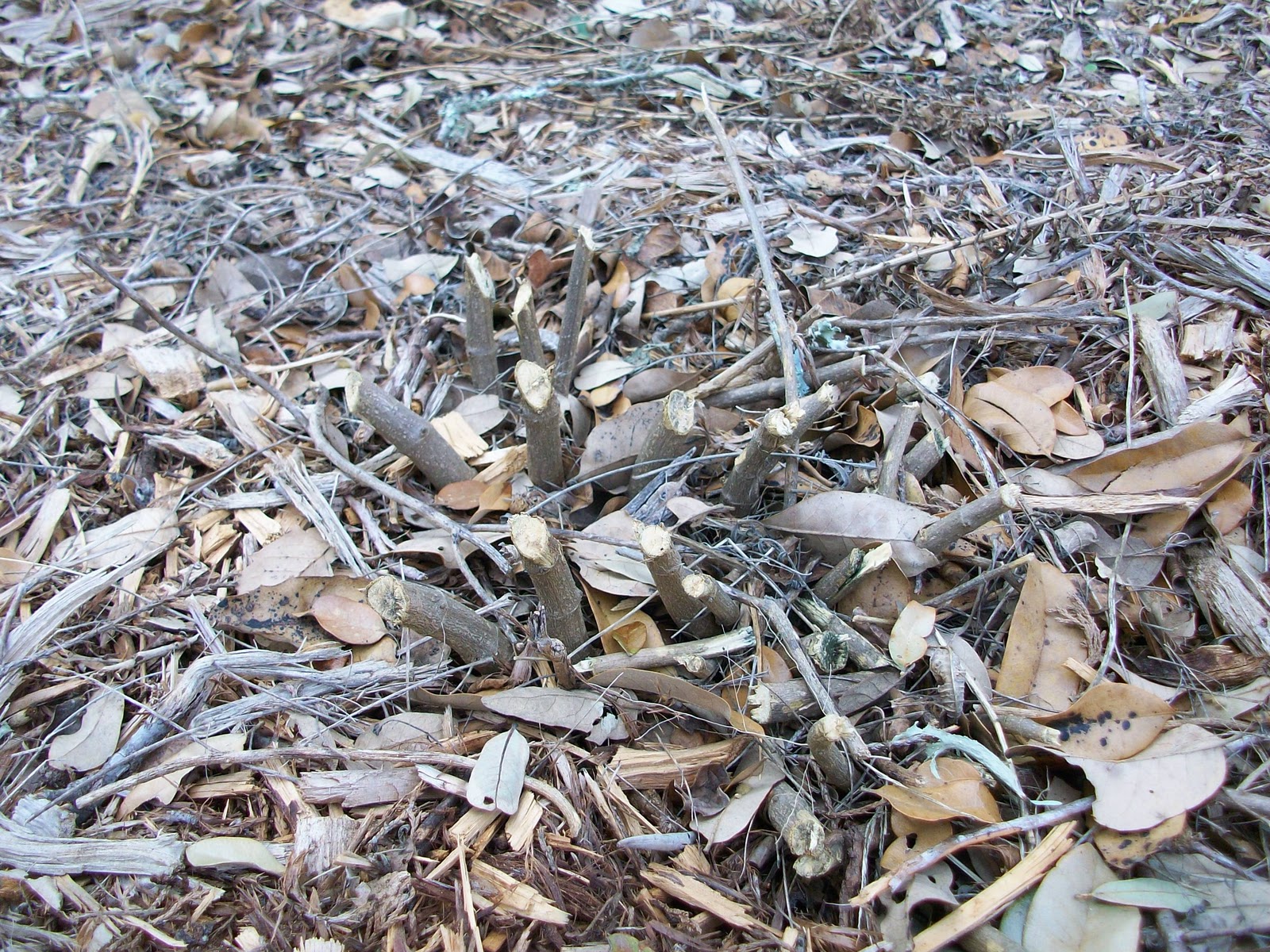 |
| Copper Canyon daisy |
 |
| Butterfly bush |
 |
| Mexican bush sage |
 |
| Wedelia (zexmenia) |


 |
| American beautyberry |
Subscribe to:
Posts (Atom)