Wednesday, January 18, 2012

Tracks and transplants


 This afternoon, I was on the phone, talking with expert tracker Jonah Evans when I happened to glance out my office window. "THERE GOES THREE DEER!" I exclaimed as they trotted across our Meadow and then ambled north to a neighbors' yard. "Hey, James, come see!"

I apologized to Jonah for yelling in his ear, and he laughed. "Oh, it's OK," he said, "but go out there and check for tracks! They left some, that's for sure." So after we hung up, I did go out later with my camera. The prints weren't that great, but I took one photograph. Then I walked over and took a picture of the four little bluebonnet plants that I transplanted last Monday from another neighbor's yard. They were growing nearly in the street, and Jeri said, yes, I could have them. Here's hoping I can keep them alive and maybe get a patch started in the meadow.

I also saw one of the antelope horn seeds that I anchored across the meadow Monday.


Bluebonnet babies
Antelope horn seed

Friday, January 13, 2012

A tree disease near Boerne

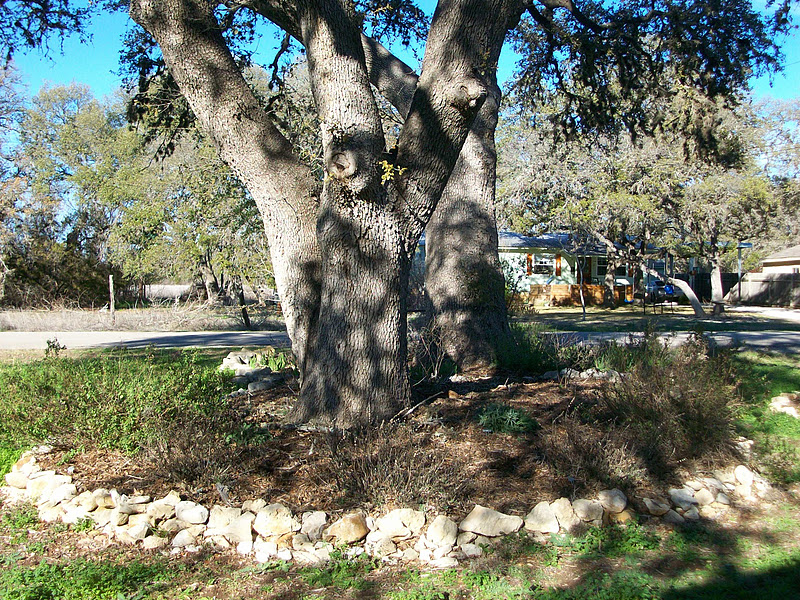
This week, my mother had several Spanish oaks (Quercus texana) cut down because they were infected with hypoxylon canker (Hypoxylon sp.). She sent photos of the fungus.

According to the Texas Plant Disease Handbook, hypoxylon canker spreads through spores, which enter through injured areas on limbs or the trunk. "Trees which have been damaged by excessive fill soil are often attacked by this organism," states the handbook. "It is also suspected to be a fungus that can invade on oak wilt-infected trees. Control is achieved by maintaining the trees in a healthy condition. Avoid injury to the trunk and limbs and never apply fill soil around the trees. Chemical treatments would not be effective because the fungus is located within the tree."

According to Texas AgriLife Extension Service's East Texas Gardening, "hypoxylon canker has been noted in the death of many oaks in the East Texas area over the last several years. This disease is not rare, but due to the stressful droughts of the last several summers, a large number of trees are being affected." 

The Texas Forest Service has more information on hypoxylon canker, too. So does AgriLife Extension.

Mom told me that surviving trees nearby were fertilized, and now she's giving the trees soaking drinks of water for several weeks. Hope they survive!


Wednesday, January 11, 2012

January 2012 in our Wildscape


Recent rains continue to brighten and green up our Wildscape. As mentioned before, we've got a LOT of henbit. It's outran the horseherb!


See how thick the henbit is growing?
I'm not sure (yet) what this "weed" is, but it feels soft and acts like a groundcover.

Sunday, January 8, 2012

Wish list

Hey, I know it's not Christmas any more. But I've been wanting to start a "native plants wish list" for our Wildscape. Wish list meaning both tried-and-true species that we've got growing and also new-to-us plants. I've dug up and potted little turk's caps and rock roses that we can plant in the spring. Some inland sea oats, too. I've ordered a copy of Jill Nokes' copy of How to Grow Native Plants of Texas and the Southwest coming so I can learn how to propagate native grasses and plants from transplants and seeds.

Here goes...this is a post in progress, naturally.

I'd like more:
   Chile pequins
   Butterfly weed
   Cowpen daisy
   Goldenrod
   Texas betony
   Wedilia

New:
Pine muhly

Friday, January 6, 2012

Worms, worms, worms

Last year, my son gave "worm farming" a shot in his Waco apartment. Suffice it to say that the farm went south. But it's such a cool idea–growing and encouraging worms in your yard. On that note, I just read "Worming his way out of ugly lawn," Roy Bragg's column in Wednesday's San Antonio Express-News, which featured Kyle Harrell and his backyard worm farm. Naturally, Harrell's got a blog: Texas Red Worms. Very interesting venture!

Thursday, January 5, 2012

Spring pretend


With days like yesterday and today, it's easy to wish even more than spring was TOMORROW! Even a pair of frisky red admirals (above) were flitting about this afternoon. With the recent rains, volunteer henbit and other nuisance natives (and nonnatives) are flourishing. Yesterday afternoon, I got out and pulled henbit from our front beds. For now, it can grow elsewhere for the benefit of bees, butterflies and other insects. When she visited Tuesday, my mother asked about henbit. Time to get out the books!


Henbit (Lamium amplexicaule) is the common name for a cool season weed, originally from Europe. It's also called dead nettle and is a member of the mint family (Lamiaceae). Howard Garrett in Howard Garrett's Plants for Texas says he likes the plant, "but if you don't, mow it down." According to Delena Tull's Wildflowers, Trees and Shrubs of Texas, "the young tender plants of both species [Lamium purpureum, East Texas species] are edible raw or cooked; unlike most mints, these do not have aromatic leaves."


And with yet another new year already here, I've decided to wage war against invasives in our Wildscape. The lantana (pictured above) was here before I moved into the Pink House in 2002. It struggled to survive last summer's drought and wasn't as hearty as usual. Though not listed at Texas Invasives, many biologists, native enthusiasts and other experts frown on Lantana camara and consider it to be highly invasive. So out it goes.

Tuesday, January 3, 2012

Purple martin friend

Good morning! I just read on Facebook (thanks Louise Chambers!) about martin enthusiast Gardner Sumner in Austin. During last summer's horrific drought and heat, he spent hours, feeding birds and cooling houses at the Virginia Avenue Purple Martin Sanctuary in Travis County. For his dedication, the Austin American-Statesman recognized him as one of their Volunteers of the Year.

It won't be long before the scouts start returning!