Wednesday, August 4, 2010

My green friend, a beetle and other happenin's

Yesterday, I was really excited to spot an ironclad beetle, one of the prettiest and most unusually marked species in our neighborhood. When I picked it up, it immediately "played dead." And it did a good job of it, too! (See below) But not for long. I let it go under the inland sea oats.


I used to pull up this stuff. Then I discovered it's a "native"–either Carolina ponysfoot or Oakswood ponysfoot. Probably Carolina. Either way, it makes a great groundcover!

And look, one of our fall obedient plants is blooming!

I snuck this photo past James. Dozens of these tiny caterpillars are devouring leaves on our flame acanthus. Several weeks ago, we snipped off an acanthus branch that was covered with caterpillars, and James tossed it across the street. This time, I let them be because I wanted to find out the species. Well, they're crimson patch (Chlosyne janais) caterpillars! I love to play investigator!

And yesterday evening, James spotted this guy–a baby Texas spiny lizard. He was a cute little thing!

Finally, last but not least, my green friend on the Jerusalem sage. She's more than doubled in size.

Thursday, July 29, 2010

Red beetle

Beetle or bug? I need to learn the differences so I can better guess in the field. I spotted this little fella this morning on a zexmenia leaf andsent this image to Bugguide.net. I guessed "red bug" (there's a family of "red bugs"). Wrong! Natalie Hernandez on Bugguide.net says "a flea beetle of some sort that has just emerged from its pupa and has not hardened yet (which is called teneral.) Its elytra will eventually harden to cover its abdomen." She said my specimen is similar to a Disonycha leptolineata.

I thought it was cool. Bright red!

Tuesday, July 27, 2010

Take a look at this sphinx!


Checked on Bugguide.net and pretty sure that this is sphinx species, Amphion floridensis. James spotted it on my potted Texas satsuma tree this evening. It was STUNNING. A deep blood red.

P.S. This sighting got Texas on the Bugguide.net map!!! Not sure what that means but I'm gonna find out....

Monday, July 26, 2010

Lost Ladybug Project and a new bug

A new ladybug species in our Wildscape! Meet the twice-stabbed ladybug (Chilocorus stigma). I spotted it yesterday while checking out spiders and bugs with my young neighbor friend, Peyton, and his buddy, Eddie. Peyton's little brother Davis, too. He wandered over later and joined us. And yes, I uploaded it to the Lost Ladybug Project.

Below is a mystery insect found in our Wildscape back in May, and I never got it identified. I posted it on Bugguide.net this morning and quickly got an ID: a white-margined burrower bug (Sehirus cinctus). Hey, I have photos of the nymphs (posted below)! I shot those May 31 in the back yard after James found a bunch of them under some rocks. Very interesting!

Adult
Sehirus cinctus

Nymph
Sehirus cinctus

Nymphs
Sehirus cinctus

Friday, July 23, 2010

New caterpillar


I spotted it on the blue mistflower this morning. And it did NOT want to cooperate with a photo-taking session. I finally plopped it in my hand, hoping it would "stand up straight." Nope. Instead, it curled up tightly and refused to show its pretty colors. I went back outside later for a second try and got a few shots but not very good ones. This specimen appears to be a yellow-winged pareuchaetes (Pareuchaetes insulata). A yellowish moth!

Monday, July 19, 2010

The life or death debate

This morning, I spotted a sparkling shell in the sunlight. A snail! Photo time. After I took a few pictures, I moved it near a rock border, out of the way so it wouldn't get crunched underfoot. Maybe that wasn't such a good idea. I later checked online, and this exotic species, Rumina decollata, isn't very nice to have in the Wildscape. According to the late John Jackman, an entomologist at Texas A&M, "This exotic snail is generally a uniform brown or tan color. The shell is about an inch long and elongate, and the tip of older snails is often broken off. It is transported in nursery stock and may accompany the brown garden snail in landscape plantings. The decollate snail is sometimes promoted as a biological control agent to feed on the brown garden snail. However, the use of Rumina decollata as a biological control agent should be considered carefully. It feeds on plants too, so it can become a plant pest even if it is beneficial as a predator on other snail pests."

To kill or not to kill? I hate to kill anything (except a few things, like mosquitos and roaches in the house). So if I run into this snail again, I guess I'll toss it across the street in the vacant field....

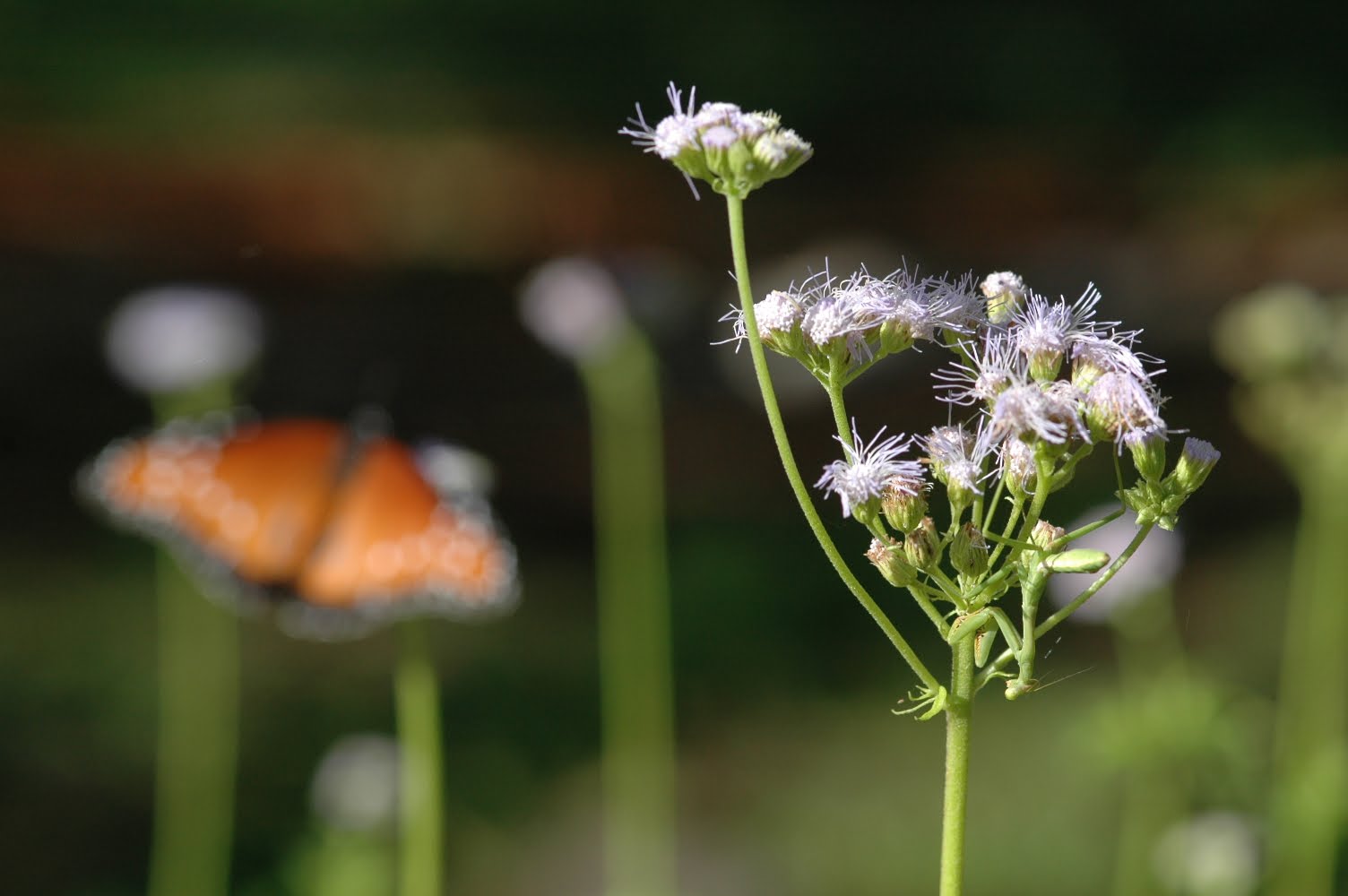
Master of disguise


So can you find someone that's lurking on a blue mistflower, hoping to grab a meal on the wing?