Friday, February 11, 2011

A mushroom from my past


In May 2007, my daughter, Lindsey, and I spotted these delicate little mushrooms in the front yard. We both took photos. Ever since then, I'd wondered more specifically what they were. Looks a like a flower, eh?

Yesterday, while researching a Texas mushroom species, I came across David Fischer's American Mushrooms website and sent him this image. This morning, he graciously answered my inquiry: "This is Coprinus plicatilis, aka Parasola plicatilis. This is one of the very few mushrooms which grow overnight and wither very quickly. You must have been up early that morning. This year, if you watch carefully for them first thing in the morning, you will almost certainly find more."


P.S. I did a quick image search of Coprinus plicatilis, and ours is definitely the prettiest! :-)

Monday, February 7, 2011

Some poop on poop (aka seed balls)


Years ago, I wrote a magazine feature on a field trip program at South Llano River State Park. Participants were middle school students from nearby Junction. The day-long outings incorporated hand-on learning with environmental awareness and appreciation. In May 1997, I joined a field trip as part of my assignment. During one workshop, I watched Bill Neiman–who owns Native American Seed–show the kids how to make "seed balls." His recipe: six parts clay, one part humus, two parts seeds (native grasses and wildflowers), and one part water, all mixed into a mushy dough and rolled into one-inch balls. The balls were left to dry and harden in buckets. After that, the kids were told to toss them around on the ground, then Mother Nature would do the rest. 

(FYI: The New York Times recently featured Native American Seed, "Emphasis on Native Plants Gains Favor Across State." And in 2007, I wrote "Go Native," an article on Bill and his wife, Jan, for Landscapes magazine.)

Yesterday, James and I went out to our land. While he was examining rocks and fossils, I looked at plants and insects. During my looking around, I happened onto some dried, golden-colored pellets and just HAD to open one....cool! Encased perfectly inside was a seed! I opened a few more and found more seeds, each wrapped within the grassy fecal matter. I'm guessing the gold pellets came from a rabbit or some other small mammal, the dark-colored ones from deer. (The seeds, I later realized, are juniper seeds. YUCK.)

This all to ponder and report because as I opened those tiny pellets yesterday, I remembered Bill and him showing kids how to make seed balls. Looks like Mother Nature knows how to make her own!!

Can you see the seed?

A close up

UPDATE FEBRUARY 18, 2011–Ran across a reference (BioKids) on animal scat, and I apparently was right! According to BioKids, the gold-colored pellets came forth from a rabbit, and the dark pellets from a white-tailed deer.  

Sunday, February 6, 2011

Bertha Dobie and me

If you're a native Texan, chances are you're familiar with the writings of the late folklorist J. Frank Dobie. Or at least you've heard of him. In 2002 or so, I wrote a profile on him for Texas Parks and Wildlife magazine. During the process of delving into his life and works, I became better acquainted with the man who's also part of my own family. See, Mr. Dobie and my late grandfather, Dudley R. Dobie of San Marcos, were first cousins. They also looked very much alike. And–like his cousin–Daddy D., my grandfather, was a writer.
Yesterday morning, I joined my Dobie clan–Uncle Dudley Dobie Jr. and Aunt Saza Dobie, cousins Rick and wife Audra Dobie, Rusty and wife Tina and their daughters, Kendall and Drew Dobie–on an outing to Southwestern University in Georgetown. There, we attended a celebration of sorts. In 1910, J. Frank Dobie graduated from Southwestern and then earned a master's degree from Columbia University. At Southwestern, J. Frank also met Bertha McKee, whom he married in 1916. She, too, wrote but focused more on gardening articles for newspapers and magazines.

In honor of Southwestern's historic connection with JFD, Steven L. Davis, author of J. Frank Dobie: A Liberated Mind and interim director of the Wittliff Collections at Texas State University, shared about Dobie Saturday. Afterward, Austin writer Sarah Bird talked about her experiences, living as a writing fellow at Dobie's Paisano Ranch. (Read more about the ranch and her time there as a fellow in The Acalde magazine, "A Literary Home on the Range.")


Sarah Bird and me
After the two talks, I visited with Sarah, then wandered over to a table display of J. Frank and Bertha Dobie papers, archived at Southwestern. A tattered brown notebook filled with lined pages of handwriting caught my eye. "That was Bertha's journal," said Kathryn Stallard, who heads the university's special collections at the A. Frank Smith Jr. Library Center. "She wrote every day about an elm tree she could see through a window of their home."

The first page of Bertha Dobie's journal...
I literally froze. "Really?" I asked. "Because that's how I came to start my blog...." I was stunned. Window on a Texas Wildscape....

Back in the car with Uncle Dudley and Aunt Saza, I told them about Bertha's journal. "Oh, yes, I remember that tree," Uncle Dud said. In the 1990s, he and Aunt Saza bought, renovated and saved the J. Frank Dobie House near UT in Austin. Today, the two-story home–now owned by the University–houses the Michener Center for Writers. "It was the great elm under which the Texas literary triumvirate of writers–Dobie, Roy Bedichek and Walter Prescott Webb–spent many evenings, talking," Uncle Dudley continued. "We spent a lot of money, trying to save it. But then a wind knocked it down."

Here's what I could read from Bertha's first page.....

The Record of an Elm Tree and a Back Yard (From a North Window)
Thus, Bertha begins her journal: "On February 9, 1929, the cold morning of the winter, a great flock of goldfinches, handsome and in their sober winter plumage, flew into the tall cedar elm (Ulmus crassifolia) just beyond the north study window. With them were a few dull-colored pine siskens. Suddenly they flew to the ground with the soft fluttering motion that makes them at a distance scarcely distinguishable from falling leaves..."

Friday, February 4, 2011

The weather people were right...SNOW


Okay, I know. It wasn't much. Not like the poor people have gotten way up north. But we did get snow last night...


Four-nerve daisy had been blooming!

Mealy sage's hoping for spring soon.


James shot some photos, too....


Tuesday, February 1, 2011

House guest

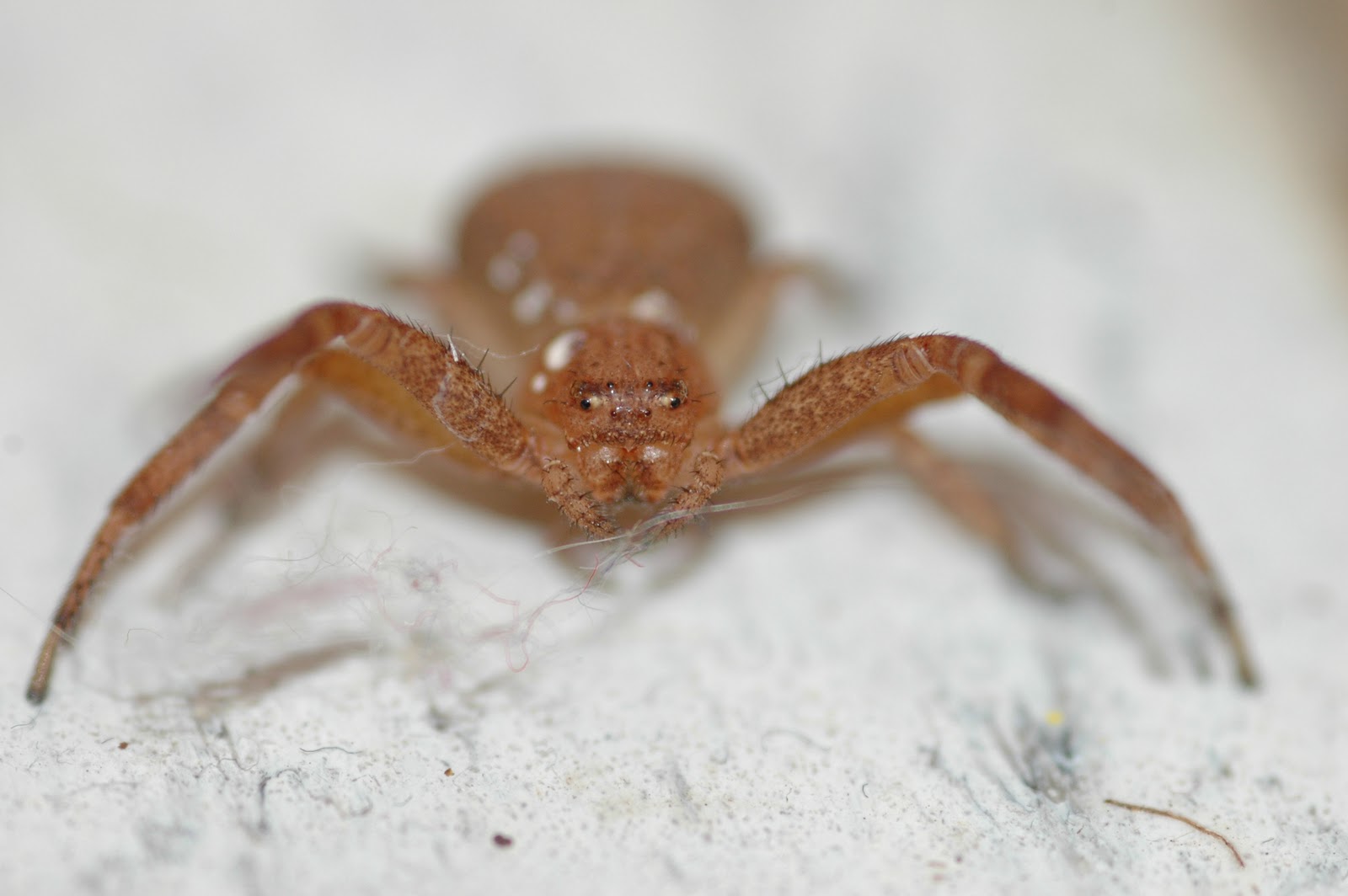
"What's THAT!?" James exclaimed awhile ago. He was standing in our dining room, pointing at a corner on the floor. Hmm, had to be somebody with a lot of legs...

"Aww, isn't she pretty!" I gushed. Then I ran for my camera...

Our lovely house guest is a female crab spider. (Please ignore the dust and fuzz on our floor.)


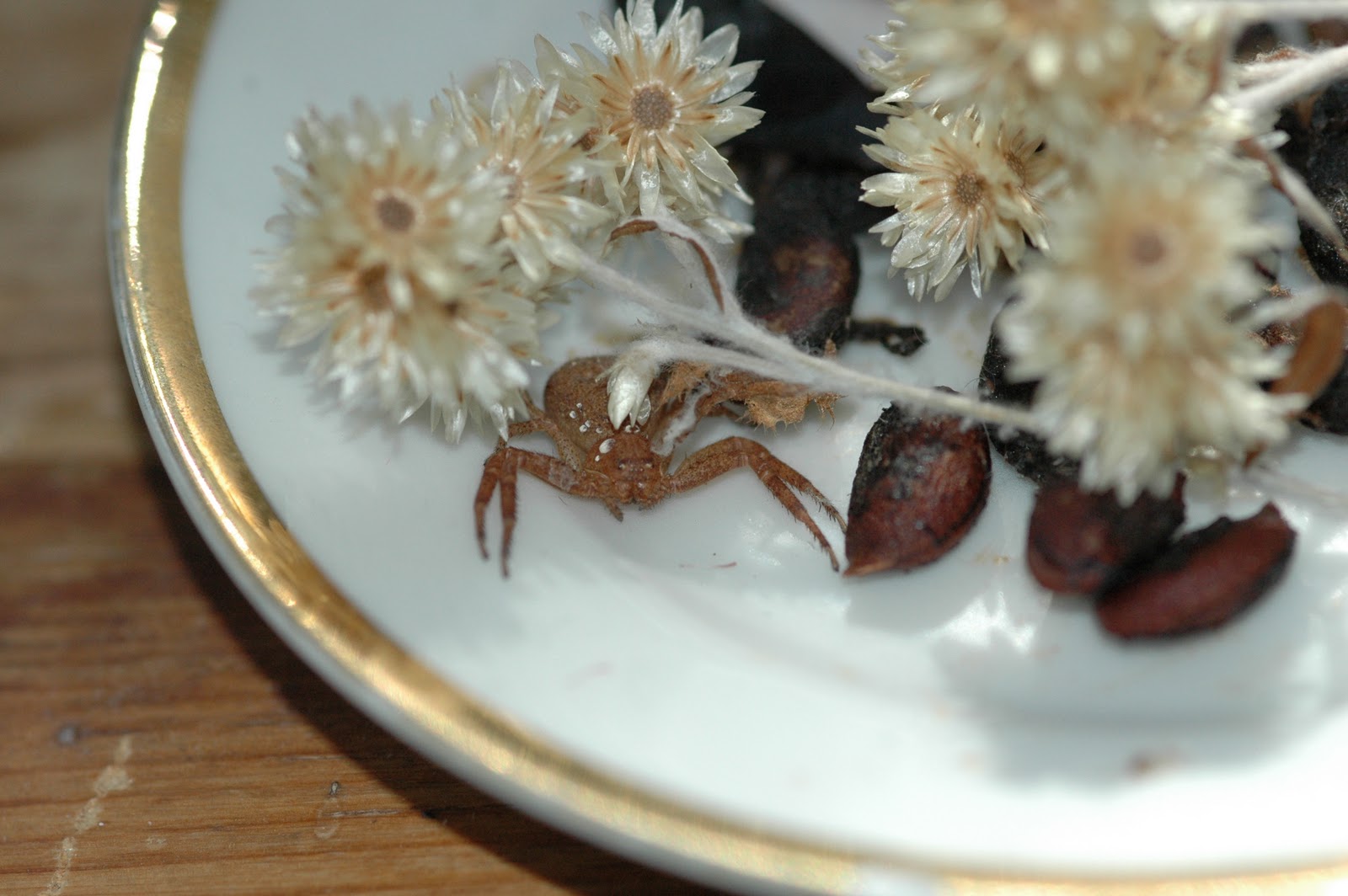
  Because it's so cold and blustery, I couldn't very well let her go outside (though I'm sure she'd survive just fine). So I deposited her in a little plate of seeds that I keep on a sunny window sill in our dining room. As you can see, she blends in quite well!


When I went back to check on her, she'd already returned to her "attack" position. That's how crab spiders hunt. They wait for a victim to happen by, then they leap onto it and administer a venomous bite.


 Welcome, House Guest!

Monday, January 31, 2011

Arctic air on the way

So I just stepped outside and trimmed some more dead blue mistflower. According to weather forecasts, a cold spell will arrive sometime tomorrow. We're due for a hard freeze, which could last several days. Which makes me wonder....should we water the Wildscape this afternoon? What do y'all think?

Sunday, January 30, 2011

Lost Ladybug Project

Seven-spotted ladybug (Coccinella septempunctata)
While we were standing in the parking lot after church, visiting with a friend, I happened to spot this ladybug on James' car. I was hoping it'd be the elusive nine-spotted species but nope, not this time either. It's the seven-spotted ladybug. Awhile ago, I shot a photo of it, then let it fly away. Then I uploaded the pic to the Lost Ladybug Project, which is surveying ladybug species across the U.S. It's a cool project! I've been contributing to it for several years now. Check it out!