Wednesday, March 7, 2012

Texas toad-flax

Texas toadflax (Linaria texana)
Along RR 1431 westward to Kingsland, you'll see two fenced pastures on both sides of the road carpeted in lilac-y purple. I wanted so much last week to stop, shoot a photo and pick a specimen. But I didn't. For one thing, the traffic's busy on that well-traveled highway. 

Today, on our way home from our chapter meeting of Highland Lakes Master Naturalists, driver Ann Cook graciously (and bravely) veered across the highway and parked in a ranch caliche entrance so Joanne Fischer and I could jump out and grab some specimens. In the front seat, Marcy Westcott cheered us on. I picked several before we jumped back in the car, and Ann took off. At traffic lights in Marble Falls, I shot a series of images of the flowers before they wilted. 

Earlier at the meeting, Jerry Stacy identified a similar species as toadflax. So that gave us a hint as to where in our wildflower field guide to look...Texas toad-flax (Linaria texana).

And I think I know how the species got its name. Tonight, I sniffed the wilted flowers and leaves....EWWWWWWW!

Monday, March 5, 2012

New butterfly species to our county? YES!!

Falcade orangetip (Anthocharis midea)

So awhile ago, I took a break after lunch and went outside with my gardening bucket, filled with gloves and tools. I was pruning the mountain sage when I happened to spot this moth. Or was it a butterfly? It didn't seem like it planned to fly off so I ran in the house and got my camera. A bit of research later, I turned up the likely butterfly species(above), which would be new to Blanco County, according to the species checklist at Butterflies and Moths of North America. 

I've got an inquiry into Bugguide.net and also a submission to Butterflies and Moths of North America (Record 700142). Isn't it pretty? I'd never seen one before.

UPDATE: I nailed the ID! Check out my image at Bugguide.net.  

UPDATE MARCH 7, 2012
Bluestem commented yesterday and directed me to a website run by the Dallas County Lepidopterists Society. I hadn't visited there in a while. He said this species is new to him, too. Click on "Butterflies of Dallas County," and search for falcate orange-tip (Anthocharis midea texana) under the subfamily Whites.

* * *

UPDATE APRIL 16, 2012-Email from Butterflies and Moths of North America

Sherylsr,
Thank you again for your submission of Record 700142 to the Butterflies and Moths of North America database on March 5, 2012.

Your sighting has been accepted, and your regional coordinator has verified your submission as Anthocharis midea. Your sighting is now represented on the map on the species page: http://www.butterfliesandmoths.org/species/Anthocharis-midea  The sighting details page is available here: http://www.butterfliesandmoths.org/sighting_details/700142

Notes from the coordinator who reviewed this record (if any): Great find!


Bird gone bad

Photo by Terry Brussel

Last Friday, Terry Brussel of Johnson City e-mailed me this lovely photo of a northern cardinal. "I found him lying on his back in the yard near my compost pile," Terry wrote me. "I sobered him up, then released him."

Please share more details, I wrote back.

"I'm not sure what he ate, but you an tell by the stain on his beak that he ate something. I picked him up, and he was somewhat lethargic," Terry recalled in a follow-up e-mail. "I took him in the house and set him on my external hard drive for about one hour. Then I took him back outside, took some photos, and he flew off."

About three years ago, we had pine siskins at our feeders that seemed a bit tipsy. We do have (nonnative, invasive) pyracantha bushes with red berries in our neighborhood. I suspect that Terry's cardinal and our siskins must have imbibed on a few. THIS cardinal's very fortunate that Terry came along when he did!  

Note: Terry later e-mailed and reported that there's no pyracantha around his house. Hmmm....

Sunday, March 4, 2012

Surveying our rural land


Another beautiful day in the Texas Hill Country! So after church and lunch, James and I loaded up and headed to our 11 acres northwest of Blanco.


Fendler's bladderpod (Lesquerella fenleri)

Pending....

Pink vervain (Verbena pumila)

Prairie verbena (Glandularia bipinnatifida)
Yellow wood sorrel (Oxalis stricta)

Whitlow-grass (Draba cuneifolia)...these were so beautiful, small and delicate.
Anemone

Lace cacti (Echinocereus reichenbachii)...thank you, Lancashire Rose!

Pending....James saw this one....

...and this one. Similar but different!


Redbud bloom with mournful thyris (Pseudothyris sepulchralis). Moth ID thanks to Bugguide.net experts.

Redbud flowers!

Beautiful Lindheimer's muhly (Muhlenbergia lindheimeri)


Hill Country rain lily (Cooperia pendunculata)

Agarita (I was happy to find one on our property.)

Seep muhly (Muhlenbergia reverchonii)

Eight-spotted forester (Alypia octomaculata)...an owlet moth. 
ID thanks to Bugguide.net experts.

Four-nerve daisy (Tetraneuris scaposa)

Friday, March 2, 2012

Adventures here in our Wildscape

BEAUTIFUL DAY! Thank you, Lord! I took my camera outside, and it was just one adventure after another in our lovely Wildscape!

 
James moved "furniture" around, namely our concrete bench.

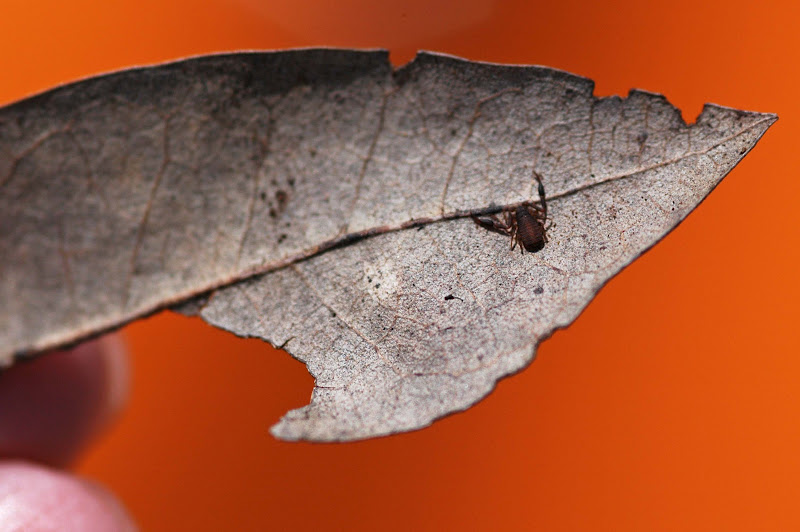
It's amazing what lives UNDER ROCKS. James pointed out this pseudoscorpion. He was a little booger to photograph because he wouldn't stand still. I was going to delete this photo, then I spotted the little spider lurking on the side of the rock. See it?


Under one big rock, we saw these larvae, likely an ant species. James wanted to go fetch killing powder, but I asked him nicely to hold off.
Then I saw this little rough earth snake, which had also been living under the rock. After I snapped a few frames, it slithered down into the leaf debris.

I believe this is wild poinsettia (Euphorbia heterophylla).

An orange sulphur (Colias eurytheme)
You just never know what's lurking among the green leaves. I spotted this green crab spider, poised and ready to grab a passing meal.

I saw something buzzing over the mulch in our back yard garden and managed to get one good shot of this scarab beetle. Perhaps Euphoria inda? 

The coral honeysuckle has been blooming a little.

And the spiderwort 'Purple' is about to burst with blooms!

Seed saga continues


I always want to make sure that my posts are absolutely accurate. But I know I do make mistakes. When that happens, I make corrections as fast as I can. Which brings me to today. I believe I've finally gotten to the bottom of the "Well-armed seed" mystery (February 15, 2012, post), which was initially solved by Texas Master Naturalist Edie Zaiontz of New Braunfels. Without a plant or flower specimen, she identified my cool, "corkscrew" seed as coming from a stork's bill (Erodium texanum). Wow, I was impressed!

About the same time, Sherri Stockman of Blanco asked me via Facebook about a pretty little mystery wildflower in her yard. Feeling a bit smug (I confess!), I pronounced it to be stork's bill (Erodium texanum). THEN a week or so later, I happened to be cruising through wildflower photos on MY blog and came across a April 12, 2010, post with an image of  Erodium texanum in bloom (right). Not the same flower! Or bloom time. Uh oh. 

Which meant I had the wrong species. (But many thanks to Edie, we DID have the right genus!)

So I returned to Facebook and, red faced, publicly correctly myself. What's blooming right now are Erodium cicutarium, commonly called redstem stork's bill or cutleaf filaree. Alas, it is not a Texas native but was likely introduced by in the 1700s by Spanish explorers. However, wildlife do find the foliage quite tasty. Rodents love to eat the seeds.

To further document this species, this morning I shot more images of the flowers and seeds.... 

Right after I snapped a few pictures of this seed, it fell off!

Bees and other insects do love the flowers.

This system of reproduction intrigues me. 
How do these appendages work in tandem with the blooms?

I pulled up an entire plant so I could see the blooms and "stork's bill" together. Sigh...this is going to involve MORE research...


   In the meantime, here's more detail on the seeds from the USDA Forest Service page on Erodium cicutarium:

"Cutleaf filaree reproduces sexually...When moist, the coiled styles enveloping the seed expand, uncoil, and drive the arrow-shaped fruit into the ground. Seed can be driven as deep as 1 inch, although seed buried less deeply is more likely to germinate...Seed either falls beneath the parent plant or is disseminated by animals. Rodents frequently bury cutleaf filaree seed in a food cache where unconsumed seed later germinates. Seed also catches on animal fur and is disseminated in that manner. Seeds of Erodium spp. can remain viable for many years, and form extensive seed banks." 


A scene from our yard.....
Why it's also called redstem stork's bill....

UPDATE March 13, 2012
More close-ups of the seeds...they just fascinate me.


Week One: The adventure begins


I first met conservationist J. David Bamberger nearly 18 years ago on a press trip to his Blanco County ranch. I was 35, a harried mother of two little ones and writing at my desk in the corner of our living room. Now I'm 50-again (for the third time) and have my own office. Then and now, even reaching far back to my childhood, I've loved  nature. When I first visited with Mr. Bamberger, habitat restoration was a new concept to me. Native grasses, important? I had no clue. But with age, I've gradually built upon my knowledge of native flora and fauna, how ecosystems are complex and interconnected, why even so-called "weeds" matter.

So it seems that my start this month in the Texas Master Naturalist training with the Highland Lakes chapter has come at just the right time in my life. I'm so excited!

On Thursday, March 1, my 19 classmates and I attended orientation at the library in Kingsland, a small community northwest of Marble Falls. Which brings me back to Mr. Bamberger. He gave our informative and inspirational keynote address to kick off classes.

J. David Bamberger
Now 83 (and still in fabulous health!), Mr. Bamberger has made tremendous progress on his 5,500-acre ranch since I profiled him for Texas Parks and Wildlife magazine in the mid 1990s. Among his many, many honors for his land stewardship, he's proudest of winning the Leopold Conservation Award in 2009 (it helped that the award came with $10,000, he jokes).

Today, his Selah-Bamberger Ranch Preserve–once the "worst piece of real estate in Blanco County"–is said to be the largest habitat restoration project on public lands in Texas. "I've spent the last 43 years, demonstrating how a damaged piece of land can be restored," he told us. "Exercising patience when working with nature was one of my biggest challenges."

When he bought the rock-riddled, overgrazed ranch in 1969, ag experts warned him against raising cattle. "We dug seven water wells and never got a drop of water," Mr. Bamberger recalled. "The soil conservation guy said I'd need 41 acres to support one cow. We also had less than 50 bird species."

Today, the ranch's bird list stands at 218. What's more, five families live full-time on Selah, and every year several thousand guests visit and stay overnight in the ranch's lodge. "All because of habitat restoration," he said.

Where's the water coming from? Natural springs that returned after Mr. Bamberger and his team began selectively clearing Ashe junipers. "It was so thick that sunlight couldn't reach the ground," he said. "But for every cedar we took out, we got 38 back. We wore out 106 lopping shears! The lesson there: Never embark on an endeavor you don't intend to sustain–that applies to a business, marriage and Master Naturalist training!" (Everyone laughed.)

After clearing the junipers, Mr. Bamberger "scarified" the land to slow erosion. The scarification also caught native grass seeds that he distributed. Two and a half years later, the springs started running again. "Grass is the greatest conservation tool there is," he said. "Keep a grass covering on your ground, and you'll have water."

"This drought isn't over yet," he interjected. "You may not live long enough to the end of it either."

As a child, his mother, Hester, taught him about land stewardship and gave him a copy of Louis Bromfield's Pleasant Valley. Bromfield's chronicles of how he restored his family's ravaged Ohio farm inspired Mr. Bamberger to find and restore his own piece of land in Texas. Like Bromfield, Mr. Bamberger's conservation efforts have been chronicled in a book. In 2008, Texas A&M Press published Water for Stone: The Story of Selah,Bamberger Ranch Preserve by Jeffrey Greene.

Back when I first met him and still to this day, Mr. Bamberger shows visitors to Selah his "historical marker," a granite tombstone that stands within its own cemetery neatly fenced with iron rails and stone walls. Someone had given Mr. Bamberger the slab of stone. So he decided he'd have it inscribed. At first, the stonecutter offered his heartfelt condolences for the Bamberger family's loss. Then he read the epitaph he was to carve: In memory of man...2,000,000 B.C. - A.D. 20? He who once dominated the earth destroyed it with his own waste, his poisons and his own numbers.

"Bamberger," the man told him, shaking his head, "I've made tombstones for canaries, cats, dogs and horses, but this is the first time I've made one for the whole human race!" 

NEXT WEEK
Our class curriculum sends us next Thursday to Wimberley, where we'll visit Jacob's Well and learn about our region's watersheds, groundwater and aquifers. In the 1950s, my Grandfather Smith retired in Wimberley on the Blanco River so I've visited Wimberley ever since I can remember. Later in life, as a reporter with the San Marcos Daily Record in the early '80s, I wrote news stories about Jacob's Well, then the site of numerous drownings. But this will be my first actual visit to the well, which has since been purchased by the Wimberley Vallety Watershed Association and become the Jacob's Well Natural Area. Can't wait!