 |
| Just thought I'd share a photo today of our stock tank pond. (I got up on a ladder for the shots.) If you look at the side of the rock nearest the pond edge, you'll see some of my gambusias swimming past. We've had children in the past few weeks, and I spotted some finally this week. I'm sure they hide in the vegetation until they get past eating size by the adults. Our little pond has inspired Martha D. in McGregor and Kathy A. in Corpus Christi to make their own! |
Friday, July 6, 2012
Stock tank update


Nature Nights at the Wildflower Center
Last night, we drove over to Austin and attended Nature Night at the Lady Bird Johnson Wildflower Center. The free Thursday events run through July 26. Last night's theme was "The Power of Plants." We got there early so we walked the trails for awhile....
 |
| Bluebonnets blooming in JULY! Can you believe it? We found these growing in a test plot on the Restoration Research Trail. |
 |
| We spotted several eastern cottontails along the John Barr Trail. This one let me get fairly close for a photograph. |
 |
| This one, on the other hand, tried to hide. |
 |
| At Nature Night, we met Commander Ben, the Invasive Hunter. He was on hand to teach kids about the danger of invasive plants in our habitats. He is one cool young man! (And thank YOU, Benjamin, for the nice mention and photo of us on your blog!) |
 |
| At other booths, kids made more nature-related crafts. |
 |
 |
| In the center's pond, a resident red-eared slider ignores nosy photographers. Like me. |
Thursday, July 5, 2012
My article in Reverchon Naturalist
During our Master Naturalist training, I met Ricky Linex, a
wildlife biologist with the Natural Resources Conservation Service in
Weatherford. He told me about Malta star-thistle, a wicked invasive that I later realized was growing in our Meadow! After sharing some e-mails back and forth about the species, he later asked me to write an article on my misadventures for the online newsletter called Reverchon Naturalist.
I just happened to remember to check and see if my article's come out yet. Yep–it sure has! To read "Malta star-thistle: Every Master Naturalist's Nightmare and Yours, Too," go to this link, then click on May/June 2012, Issue No. 15.
I just happened to remember to check and see if my article's come out yet. Yep–it sure has! To read "Malta star-thistle: Every Master Naturalist's Nightmare and Yours, Too," go to this link, then click on May/June 2012, Issue No. 15.
Plants for Pollinators
Like usual, I research one topic, and I'm drawn to another. Michael Warriner wrote a great piece, "Native bees in Texas," that's posted on the Native Plant Society of Texas website.
Toward the article's end, he writes, "A great online tool for determining which native plant species are best for your ecoregion of Texas can be found on The Pollinator Partnership’s website. Simply type in your zip code and you will be directed to a downloadable ecoregional-specific planting guide."
Okay, so Sheryl stops and types in her zip code....
Then she learns that her Wildscape falls within the "Southwest Plateau and Plains Dry Steppe and Shrub Province."
Another click, and Sheryl gets a PDF of "Selecting Plants for Pollinators: A Regional Guide for Farmers, Land Managers, and Gardeners in the Southwest Plateau Dry Steppe and Shrub Province (including parts of New Mexico and Texas)."
Cool! On her tablet, she saves the PDF in iBooks so she'll have it for future reference.
Now back to work. Right?

Toward the article's end, he writes, "A great online tool for determining which native plant species are best for your ecoregion of Texas can be found on The Pollinator Partnership’s website. Simply type in your zip code and you will be directed to a downloadable ecoregional-specific planting guide."
Then she learns that her Wildscape falls within the "Southwest Plateau and Plains Dry Steppe and Shrub Province."
Another click, and Sheryl gets a PDF of "Selecting Plants for Pollinators: A Regional Guide for Farmers, Land Managers, and Gardeners in the Southwest Plateau Dry Steppe and Shrub Province (including parts of New Mexico and Texas)."
Cool! On her tablet, she saves the PDF in iBooks so she'll have it for future reference.
Now back to work. Right?
P.S. Check out the FREE app, BeeSmart Pollinator Gardener.
Bee boxes, houses and other nesting quarters
Wow. I thought I was doing well when I made one simple bee box a few years ago. This morning, I'm researching the topic online and have found AMAZING bee nurseries. For instance, check out Bee Houses Around the World at Resonating Bodies blog and see an awesome "bee city" that stands in the Botanical Garden in Zurich, Switzerland.
At a landscape designing blog called Studio G, see a collection of "bee wall" photos. Many of the photos, I think, come from Wildbienen ("Wild Bee"), which looks to be a German blog. I could be wrong, but the language is definitely not English. :-)
Here's a way cool photo taken by Nicolas Vereecken of a magnificent bee hotel in the Jardin des Plantes in Paris. Take a look! See more more more photos of bee houses at Hymenopteran Housing Projects Pool page.
Want to learn more? I found:
* An information sheet on Bee Hotels by Robin Dean.
* At the Pollinator Garden blog, Marc Collin wrote a post on "How to make a Bee Hotel: A house for mason bees and other solitary bees."
* The U.S. Fish & Wildlife Service has a Pollinators page with info on building bee boxes and a link to more instructions, "Encouraging Native Pollinators."
* The Xerces Society for Invertebrates Conservation has an info sheet, "Nests for Native Bees."
* Even the U.S. Department of Agriculture has instructions, "Build a Nesting Block."
Gee, I don't feel so clever now!
Monday, July 2, 2012
After the rains

Yesterday, God blessed us with a little more than an inch of rain! I was sitting in my office, reading, when I happened to glance out the window. Tiny winged insects were flying upward from the ground and into the sky. Apparently, the moisture had triggered their emergence. What were they? I ran outside with my camera and caught a few in my hand. The photos aren't great, but I did my best....
UPDATE...BAD NEWS! THOSE WINGED THINGS ARE TERMITES! Likely a native subterranean species. Ugh! I'm reading up now about them, including a FAQ posted online by AgriLife Extension. They were swarming yesterday....

 |
| James walked outside, too, and spotted this small toad in the Meadow. |
 |
| The raindrops on the lilies in the stock tank pond were pretty.... |
Saturday, June 23, 2012
Now THAT'S a BIG beetle!
 |
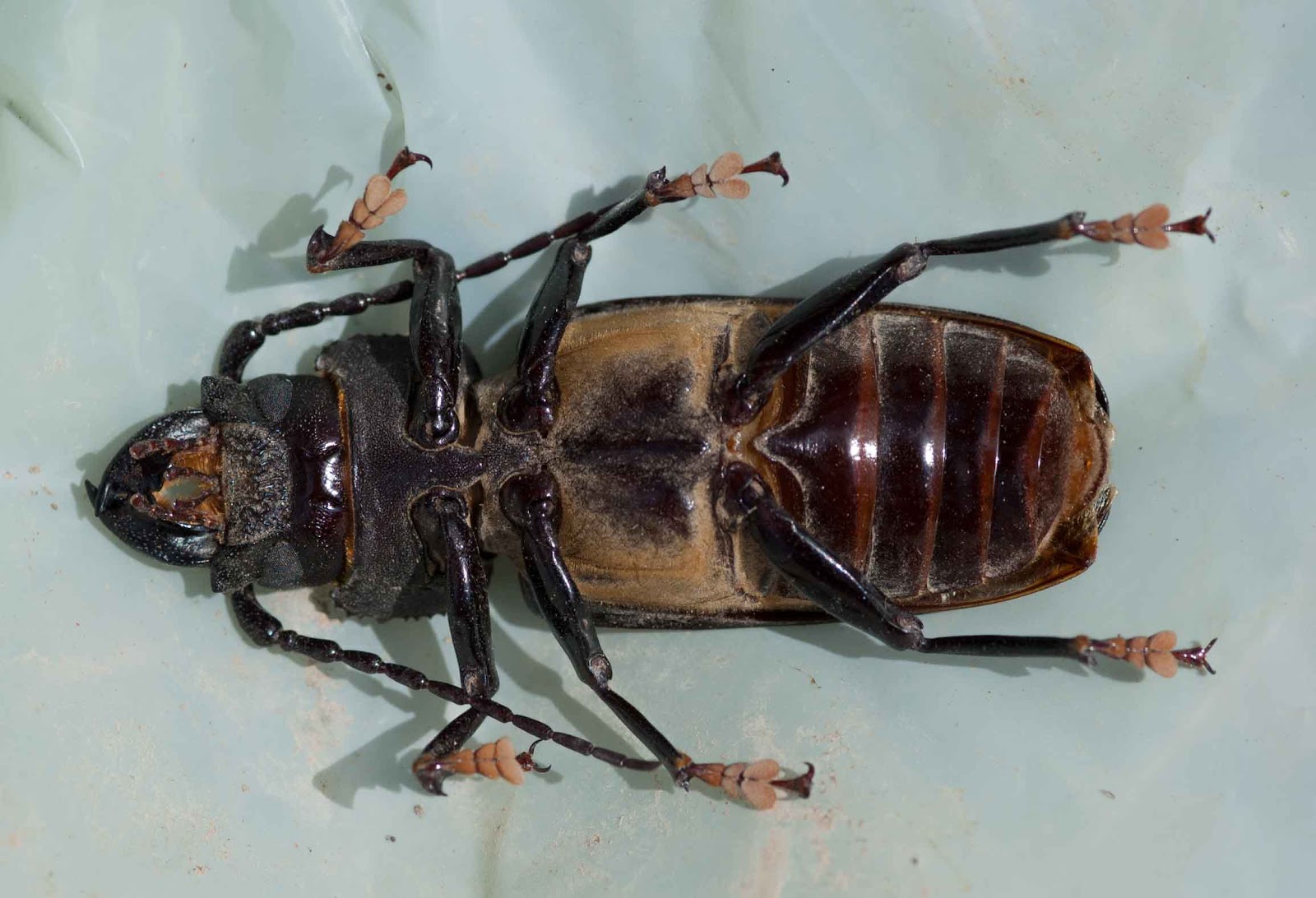
| James has been making some pretty darn good finds lately. Awhile ago, we were outside, walking around the Wildscape, when he walked over to the street side to pick up a beer bottle in the ditch (HOW CAN PEOPLE THROW OUT GARBAGE LIKE THEY DO??!!). Then he spotted something moving around....this huge beetle! I went for my cameras and snapped some shots. Then a few minutes later, the poor guy DIED! At least, we thought he died. At any rate, he was already in puny health. |
 |
| I check my Peterson Field Guide, and I believe this big beetle to be a hardwood stump borer (Mallodon dasystomus). |
Subscribe to:
Posts (Atom)