Saturday, July 20, 2013

Look what we've been up to


Earlier this week, I ran across a listing for a bird bath/water fountain available in San Marcos. As you can tell, we bought it! And OH MY GOODNESS, IT WEIGHS A TON! Or least 250 pounds all together. It came in three pieces. The finial top was easy. Now the bowl and separate pedestal, well, I'm relieved to report that no back aches to be had.

I also found this cute wrought iron bistro set at an estate sale here in town. I knew the woman, who was a retired school teacher and very active locally. Rebecca was especially involved in a "Keep Blanco Beautiful" campaign. I was thinking this morning that she never did see our yard. Especially the back, where we've done so much work. She would have loved our Wildscape. 

Monday, July 15, 2013

Free bee (and ant) observer cards

I've been meaning to pass this on for the LONGEST time. But sometimes life just gets in the way....

"The Entomology Department at the Harvard Museum of Comparative Zoology and the Encyclopedia of Life have collaborated to develop a set of "Bee Observer Cards" that are intended to teach naturalists, teachers, resource managers and other interested public something about the diverse anatomy, natural history, and behaviors of bees. The cards are not a guide to taxonomic identification but more a tool to help people observe the remarkable diversity of body structures, nesting habits etc. when they are out in the field. 

They are freely available to anyone as a PDF on the EOL website: http://eol.org/info/disc_observer."

P.S. from Sheryl–There are ant observer cards too!

Wednesday, June 19, 2013

A chapter closes


Today a chapter in my mother's family closes. Actually, it's more like a book. Today, the San Marcos home that her parents had built in 1938 and where she and her two brothers grew up will change owners. This special place has been in our family for nearly 75 years. Today, someone else will begin a new chapter within its rooms and hallways. 

As a little girl myself, I spent many a summer day there, sitting in the grass beneath the sycamore trees. Balancing on the metal bars where visitors once tied their horses. Imitating the call of mourning doves perched among the pecan leaves. Playing a board game with my sweet (and patient) Uncle Jim. Digging through my fancy play purse, a hand-me-down filled with goodies by my grandmother, Debbie. Eating vanilla ice cream (topped with cherry juice) with Daddy D, my grandfather. "Tastes like more, eh?" he'd grin at me. Oh, yes!

That's life. A series of endings. And beginnings. I wish much happiness to the new owner. I really do! And I hope to nurture a little piece of my family's San Marcos home in our own yard...a small yet unidentified plant that was growing like a weed near the street. I'm guessing it's a species in the mint family, but I'm not sure yet.   


Monday, June 17, 2013

Get that grass!


For a long while, I'd been eyeing this colony of invasive Johnsongrass (Sorghum halepense) that's growing in a field across the street. According to the Texas Invasives database, "Johnsongrass is considered one of the 10 most noxious weeds in the world." So while I was over there in the field, photographing invasive nandina, I pulled on my green gloves and then pulled out that nasty bunch of Johnsongrass. It's gone now.  


Last spring, I learned in my Texas Master Naturalist classes to look for a tell-tale marking. Johnsongrass always has a distinctive white line up the leaf.
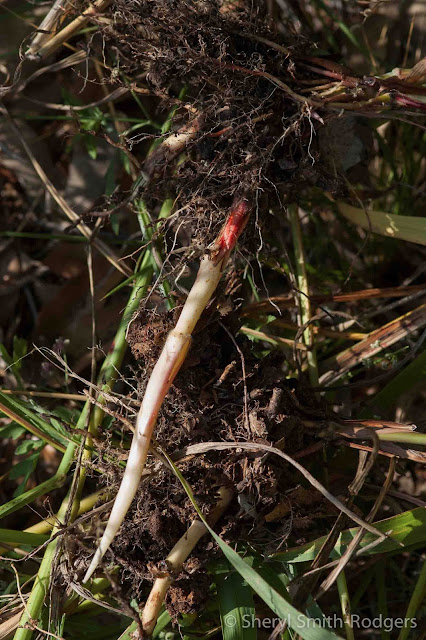
The species, which was brought to the States as a forage crop in the early 1800s from the Mediterranean region, has vigorous rhizomes. And that's no lie! Just look at this one!
I didn't pull up all the Johnsongrass. There's more. And only one of me. Plus, I decided that maybe I'd better ask the owner first.....

Tricked...or not?

A native flameleaf sumac? Or...HORRORS...a nandina?
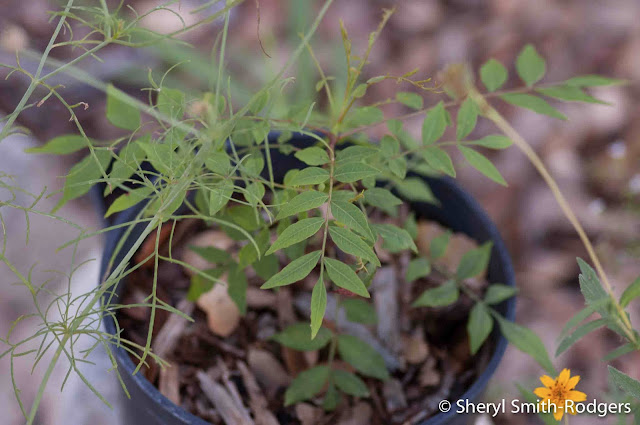
Last fall, James spotted what he thought might be a flameleaf sumac growing at the edge of our front cement porch. So he dug it up, and I've been nurturing the mystery sapling in a plastic pot. Here lately, I've been suspecting that maybe it's a poser. As in...an invasive nandina (Nandina domestica). Major YUCK. They grow in the neighborhood, both invited and as a volunteer. I walked across the street this evening and took some leaf close-ups on a volunteer nandina that's growing in a field. 

I've pulled up leaf images of both plants and am still scratching my head. But I'm back to thinking that I'm tending a flameleaf sumac. I SURE HOPE SO! But then I look at more leaf images and conclude NAW, IT'S NANDINA!

Guess I'll think about this dilemma another day....

Nandina branch

Sick frits


Melt and Wilt. 
Zombie disease. 
Black Death. 
NPV, short for Nulcear Polyhedrosis Virus.

I've found a number of different names for what's sickening some of our Gulf fritillary caterpillars on a passionflower vine. Yes, they're dying again. I first reported on this phenomenon three summers ago ("I feel like a murderer," June 14, 2010) and again last year ("More caterpillar deaths..." March 30,2012). It's very frustrating. In 2010, I cut down the passionflower vine on which the affected cats were dying. That seemed to help. But I still see caterpillars sickening, blackening and dying. 

Last year, I also saw other caterpillar species dying to I posted a photo at Bugguide.net. That's "possibly a baculovirus, which causes caterpillars to liquefy and eventually splash new virus particles onto the leaf, which may then be consumed by more caterpillars," replied Ian Stocks. He pointed me to a 2003 academic article in the Journal of Invertebrate Pathology: "A newly discovered baculovirus induces reflex bleeding in Heliconius himera."

So what IS a baculovirus? Google the word, and Wikipedia's definition will make you yawn...The baculoviruses are a family of large rod-shaped viruses that can be divided into two genera..." (Wikipedia even has a disclaimer: "This section may be too technical for most readers to understand." AMEN!) 

Here's the rest of Wikipedia's definition: Baculoviruses have very species-specific tropisms among the invertebrates with over 600 host species having been described. Immature (larval) forms of moth species are the most common hosts, but these viruses have also been found infecting sawflies, mosquitoes, and shrimp. Although baculoviruses are capable of entering mammalian cells in culture they are not known to be capable of replication in mammalian or other vertebrate animal cells. Baculoviruses contain circular double-stranded genome ranging from 80–180 kbp."

Now THAT explanation sure helps understand what's afflicting our caterpillars....

From what I can gather (from sources like NPR, NewScientist and National Geographic), "the government" sprays a baculovirus on trees to control gypsy moth outbreaks. However, researchers involved in the project reported on in 2011 by the aforementioned sources were more interested in how the baculovirus affects caterpillar behavior.

Personally, I want to know if this so-called pathogen is spreading to other caterpillar species, namely our Gulf fritillary cats!    

I've emailed Dr. Kelli Hoover at Penn State's Entomology Department (who conducted the 2011 research) but as yet have not received a reply. I also messaged a researcher associated with the 2003 research on baculoviruses and Heliconius himera (Gulf fritillary) caterpillars. Dr. Boucias wrote me right back and asked that I send him a sample caterpillar! 

"I would agree that the images look like the insects are infected with a baculovirus," he told me. "I should be able to readily confirm if this in fact is the cause."

Stay tuned!