Monday, September 17, 2018

Busy evening


 After I found the trapdoor spiderlings, James spotted this FAT caterpillar, likely a sphinx species, in the American beautyberry. It was HUGE. It's a rustic sphinx larva (Manduca rustica).


 Twice-stabbed ladybug eating an oleander aphid.
 Another ground beetle wandering along....

Trapdoor spider babies


Every few days, we dump out the bird baths and refresh the water. Which is what I did this evening. I just happened to notice a "knob" of some kind on the side of one bird bath. What was that? I stepped up closer and looked....trapdoor spiderlings! Oh, my goodness! Such a cool find! But I felt bad, too. I sure didn't mean to bother them. I think the water splashed right over them. These spiders typically burrow in the ground. James theorized that maybe the mama moved them up because of all the rains? Maybe so.


Wednesday, September 12, 2018

Farewell to a friend

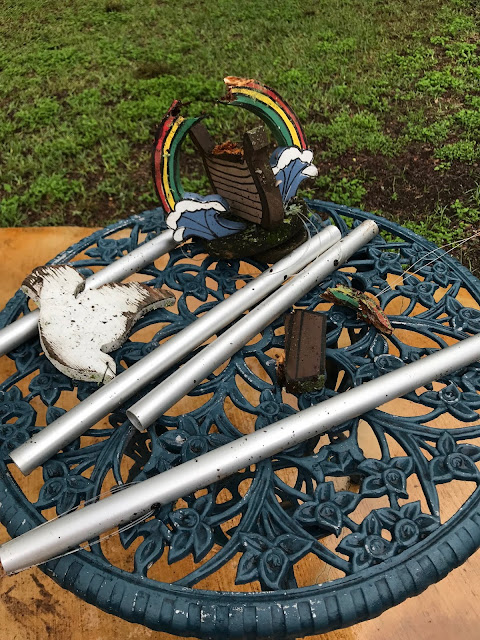
For nearly 20 years, this wooden wind chime of Noah's Ark hung both in my former yard and our Wildscape. Patrick, my son who's half past 31, presented it to me for my birthday probably around 1999 or 2000. The chime was handmade and painted by our dear friend, Martha, who's now serving as Blanco mayor. This morning, I was sad to see its rotted condition when James rapped on my office window to show me. 

Farewell, friend. Thank you for your many years of sweet jingles.


Friday, September 7, 2018

I love mallows (plus a surprise)

 Narrowleaf globemallow (Sphaeralcea angustifolia), Blanco County
 Velvet-leaf mallow (Allowissadula holosericea), Wildflower Center's October 2014 native plant sale.
Narrowleaf globemallow (Sphaeralcea angustifolia), Brewster County
Indian mallow (Abutilon incanum), Medina County

A funny thing happened on the way to this blog post....I had assumed this plant to be a globemallow. In fact, some months ago I'd even given it its own garden label to that effect. Recently I posted the above image to iNaturalist, hoping to confirm my plant's ID. In the meantime, I nosed around and figured out that this "globemallow" is actually a showy fanpetals (Sida lindheimeri), which is a globemallow cousin. Where did it come from? I wish I knew. I pulled it as a seedling from the sand in our brick patio last year (or the year before?) and relocated it to its present flower bed.  
 * * *
For the record, we had a gray globemallow (Sphaeralcea incana) that we bought from the Wildflower Center, but it died. Sniff. I still miss it. It was so pretty.

Thursday, September 6, 2018

September surprise

Here they come–September surprise, also called oxblood lilies. I took a photo of the first one to bloom. When I was out and about yesterday evening, the shoots were just poking up from the ground. They sure shot up fast!
* * *
 September 7, 2018


Wednesday, September 5, 2018

Not for the faint-hearted

I'd been greeting and waving at my Arizona praying mantid (Stagmomantis limbata) friend for awhile. She lives in some salvias. Then last week I noticed something not quite right. There appeared to be some hanky panky going on, but someone lacked a head. I posted my observations to iNaturalist.
Mantodea shared some interesting information: "Cannibalism during mating is indicated within 8 to 20 percent of encounters, with low diet females being more likely to attack the male. When cannibalism during copulation occurs, the head and prozonal area of the male’s pronotum is generally consumed while the remainder of the male’s body remains in copulation, which may continue undeterred for another 20 hours or more" 

Mantodea (Kris Anderson) also shared a link to his mantid project, "Praying Mantises of the United States and Canada."  Cool!


Rufous girl

 Last week, we spotted what we thought might be a female rufous hummingbird (Selasphorus rufus). James worked and worked to get some good shots (I was out of town). And he succeeded! What's more, the folks at iNaturalist agree with us! Check out our observation. P.S. The last time we had a rufous was back in December 2012. So this is quite exciting.