Wednesday, March 6, 2024

This is why I weed by hand

"Don't you want to use a rake?" James asks me quite often whenever I'm weeding by hand.

"Nope," I reply as I continue to pull henbit, chickweed and bedstraw. "I want to see what I'm pulling."

Yesterday, I was QUITE surprised when I pulled away dying henbit and chickweed and found THIS in a backyard bed. A bluebonnet! Wowzer! 

After supper, James ambled up while I was working. 

"So, what do you think THAT is?" I stood up and pointed to the plant I'd just found.

"Hmmm," he thought. Then he shrugged.

"A BLUEBONNET!" I exclaimed. "That's exactly why I don't want to use a rake!" 

Humbly, James smiled. "Well, that's pretty cool," he said.


UPDATE MARCH 18, 2024 Alas, the stem broke off at the ground soon after our bluebonnet bloomed. I put the flower in a little vase on our dining room table. I am sad.


Tuesday, March 5, 2024

Live owl cam at Wildflower Center

Check this out, folks! So cool.


MEET ATHENA

 The Wildflower Center’s resident owl

For more than a decade, the Wildflower Center has been home to a nesting pair of great horned owls (Bubo virginianus). Lucky for us — and our guests — the female, who we call Athena, nests in a very conspicuous place, right above the entrance to our Courtyard in the sotol (Dasylirion wheeleri) planter nestled in the north corner. When conditions are right and her eggs hatch into owlets, she provides a rare opportunity to view a wild great horned owl rearing her young.

Saturday, March 2, 2024

Master Gardeners rescue volunteers

For at least the third time, Blanco County Master Gardeners came to our yard to dig up native plant volunteers growing in the mow zone. They'll be sold at the April 20th plant sale on the Blanco courthouse square. 

Prima was on hand to meet and greet, of course. Shown are Megan Soltesz, Bernadette McFarling and Suzanne Stevenson. It was super windy, but we got a lot of plants dug up and bagged for potting later.


Tuesday, February 27, 2024

Owls in both boxes!


So this is very exciting news! We’ve had two Owl Shacks up since 2008. In recent weeks, we’ve been seeing one eastern screech owl (top photo) roost regularly. Then yesterday, I observed an owl in the same box, but it behaved differently. Its head was just above the opening. Then it dropped down and vanished. 

Well, this evening, I looked over at our other Owl Shack in the Meadow and saw an owl roosting in that one! Then it disappeared. But when James and I were both in the back yard, I glanced over at the box in the Meadow and the second photo is what I saw! An owl peeping out! Meanwhile, the other owl was roosting in the other box, as usual. Fingers crossed that we have owlets this year. As far as we know, we haven’t had a brood in a box since 2009.   

Tuesday, February 6, 2024

A cool mushroom


A few days ago, Donna Ledvina, a Blanco friend, texted me this photo. She'd found it near her home here in town. "Can you tell me what this is?" she asked. "A mushroom?"

I did a bit of sleuthing, and, yes, a mushroom! A very cool mushroom. I've never seen one in person before.

"It's in the genus Phallus," I texted back. "Also called stinkhorns." 

As you might guess, the botanical name refers to the mushroom's – uh, hmmm, well – you know, SHAPE while the common name describes its not-so-pleasant aroma. Very interesting! Thanks for sharing, Donna!


Friday, February 2, 2024

Our mygalomorph residents

Uh, what did you just say, Sheryl? Mygalomorph? What the heck is THAT? Well, you're in luck today because I'm going to tell you. The funny-sounding name refers to one of two groups of spiders. Mygalomorphae are large-bodied, long-living spiders, such as tarantulas, purseweb and trapdoor species. The other spider group is called Araneomorphae, which includes nearly all the other "true" spider groups – jumping spiders, wolf spiders, orbweavers and lynx spiders, to name only a few.

Lucky you again – now I'm going to share the four mygalomorph spider species that I've documented in our yard. I've recently spent several hours, researching them so I can better understand their differences myself. 

By the way, we've never met in person, but Dr. Norman Horner and I have been long-distance friends and spider fans since the 1990s. Back then, he was teaching the only arachnology course that I knew of in Texas at Midwestern State University. My secret aspiration was to attend it someday. Instead, I taught myself the little bit I know about spiders. But I digress. Dr. Horner has since retired and is now a professor emeritus of biology (and the former director of MSU’s Natural Laboratories). I emailed him for his opinion on my mygalomorphs. Here are parts of his reply: "...Congratulations on finding female trap doors in your yard! The females usually stay close to home and you have to dig them out! Congratulations, that does not commonly happen.

"Checking distribution records, yes, it is possible for you to have all of these species in your yard. I would think there would be too much competition for them to all be in such a confined space, but all of them are found in Texas.  Literature shows 69 species of Ummidia!"

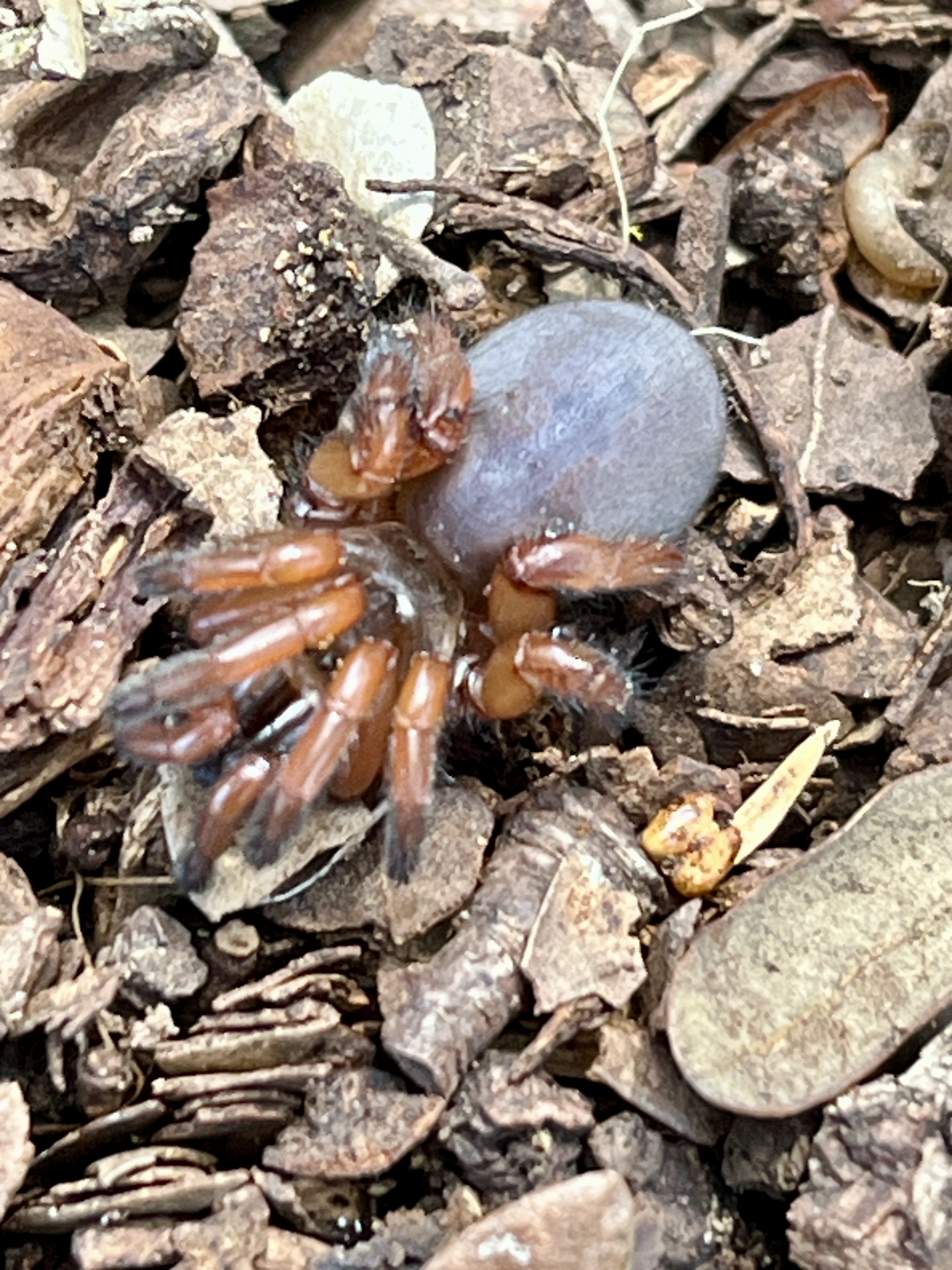
Comstock's wafer trapdoor spider (Myrmekiaphila comstocki) Wafer-lid trapdoor spider family (Euctenizidae)

Per Common Spiders of North America by Richard A. Bradley, "burrows have been found in areas of thick leaf-litter in the woods.... The burrow has a wafer-think trapdoor. There may be a branch within the burrow that has a second trapdoor."

I found ours in leaf litter beneath one of our live oaks. And I'm guessing the spiderlings I found in 2018 are this species, too.

Ummidia sp., male
Cork-lid trapdoor spider family (Halonoproctidae)

From Common Spiders of North America, "the female is a dark brown or black spider with a round body and short legs. The male is black with longer legs and sometimes with a lighter-colored abdomen.... The burrows of this spider have a hinged, thick cork-type trapdoor. When closed, the burrow and its doors are well camouflaged and difficult to detect." 

We have found this trapdoor in our gardens twice: here and here.

Ummidia sp., female

Southwestern trapdoor spider (Eucteniza relata), female  
Wafer-lid trapdoor spider family (Euctenizidae)

Per Bugguide.net, "they form burrows usually closed with a trapdoor. Webs are used to line the burrow and form a hinge for the trapdoor."

I found the beautiful girl above in 2008. 

Southwestern trapdoor spider (Eucteniza relata), male

Euagrus chisoseus
Funnelweb spider family (Euagridae)

This spider has long spinnerets that are held in an upward, curved position. Per Spiders of North America, "the web consists of fine but tough sheets with several funnel-shaped openings mostly hidden under a rock, log or other debris. Some of the sheets and funnel webbing may extend well out into the open. The spider usually remains in the retreat but may rest near the mouth of a funnel at night."

Tuesday, January 30, 2024

Trapdoor spider lady


What an extra special find today in our gardens! I was in the back yard, pulling henbit and chickweed (SO MUCH OF IT!). After I pulled away some hairy roots, I spotted some legs. Oooooooo! I accidentally uncovered a beautiful, young Comstock's wafer trapdoor spider (Myrmekiaphila comstocki). Happy, happy!
 
I found my first trapdoor spider 16 years ago. It was a female. Three years ago, we actually found a trapdoor and later another one. In 2018, I found oodles of newly hatched babies. So cute!